
Description
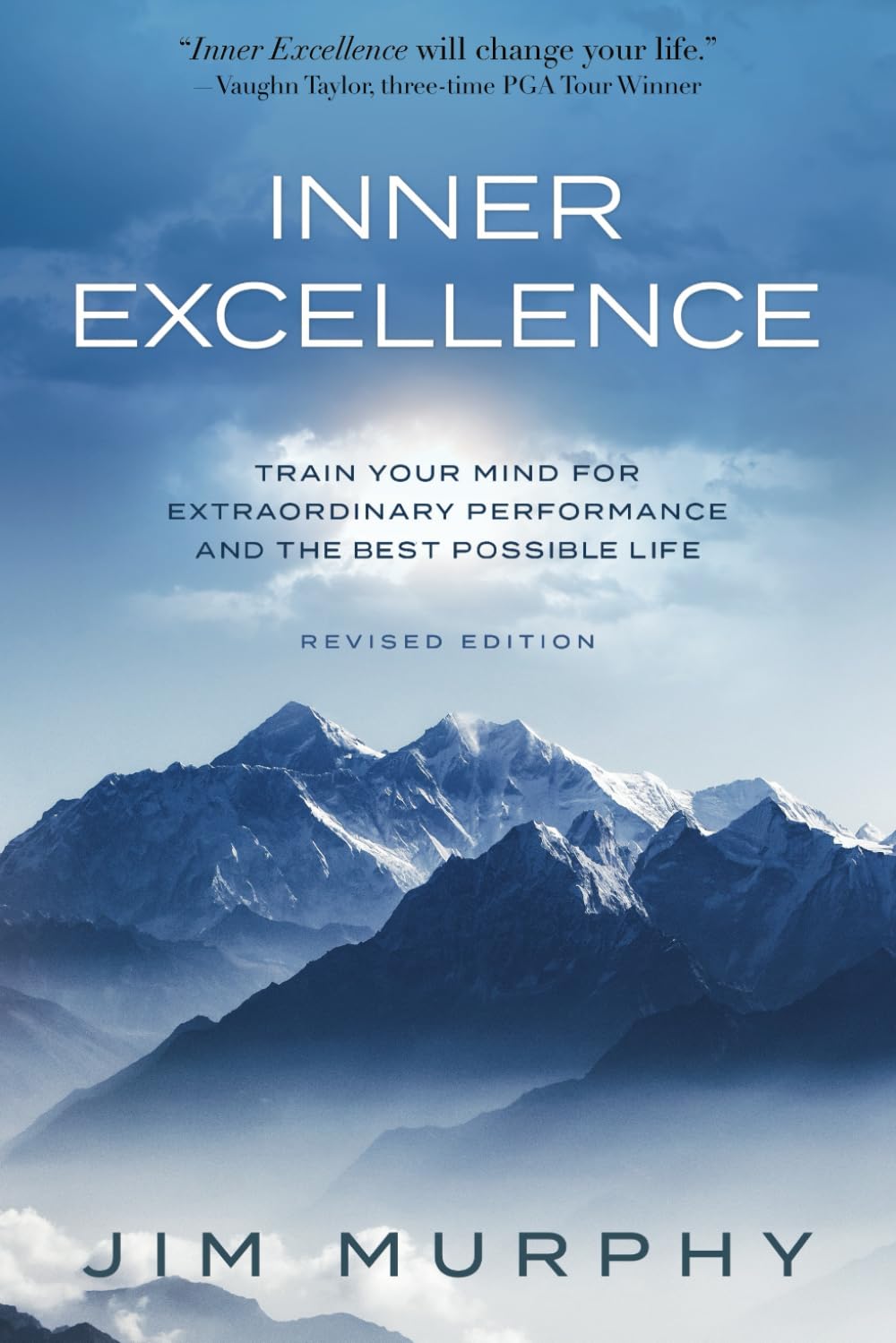
In late 2003 Jim Murphy moved to the Sonoran Desert with a Churchill line — those destined for greatness must first walk alone in the desert — scrolling across his laptop screensaver. He gave away half his possessions, got rid of his television, left his girlfriend. Over the next five years, working sixty to eighty hours a week, he interviewed sport psychologists and Olympic coaches about how the mind holds steady under pressure. That founding scene tells you something Inner Excellence never states quite so plainly: it is a book written from monastic conviction. The advice inside carries the certainty of someone who went into the wilderness expressly to come back with a message.
The message, distilled: your self-focus is what is undoing your performance and your life; surrender it, and everything else follows. Murphy calls the result “selfless actualization” (his edit of Maslow) and organizes it into three pillars — love, wisdom, courage — that become passion, purpose, poise. The framework has clarity, and the client stories that anchor it are the best material in the book. Ryan Dodd wakes up in a Flint alley with a fractured skull and comes back to win three consecutive waterski world championships. Steve Sax’s throwing yips dissolve six hours after a conversation with his father. Georges St. Pierre stops trying to defeat his pre-fight terror and starts accepting it. These are told with the plainness of someone who has sat across from these people and taken notes.
Underneath the sports-psychology surface, though, something else is carrying the argument, and Murphy is oddly reluctant to name what. Consider his passage on hurry. “Stress is a choice. You are not stressed because of your situation, you’re stressed because of what you think about your situation. When you hurry, you choose stress. You choose not to believe that everything is working out for your good, that God hasn’t got you, that you need to try and control things that you cannot.” That pivot from cognitive reappraisal, a standard therapeutic move, to faith in a personal, providential God happens mid-sentence, without warning, and Murphy performs it with total confidence, as though the two claims sit at the same level. They do not. One is a skill. The other is a metaphysical commitment.
The book is thick with this fusion. “Everything is here to teach me and help me — it’s all working for my good” is Romans 8:28 in first person. The closing invitation — “Seek first to develop your inner world — and all your relationships — and everything else will be added to you” — is Matthew 6:33 with a small edit. The presuppositions, the joy-versus-happiness distinction, the founding proposition that all performance failure reduces to self-centeredness — these formulations are theological in origin, and the book knows it. Murphy states plainly in the FAQ that the purpose of his life is to share God’s love, wisdom, and courage.
The disavowal arrives in the same FAQ. Asked whether a reader who only wants to win an Olympic gold medal needs to clarify their life purpose and focus on love, wisdom, and courage, Murphy says no. Many people, he notes, have won world championships without doing any of that. It is presented as reassurance. It reads more like a quiet admission that the mechanism the book has been describing for four hundred pages is not the one that actually produced the wins it keeps citing.
Which is the difficulty. Strip out the theology and Inner Excellence becomes a competent gathering of familiar performance material — meditation, visualization, values clarification, servant leadership — all of which are available in leaner books. Keep the theology, and the advice becomes a specific spiritual formation program that requires the reader to believe a benevolent order is holding everything, that suffering exists to develop them, that surrender of the self is available as felt experience. Murphy is honest, in a small aside about sitting in Ricky’s apartment in Los Angeles listening to a friend play a spiritual song on guitar, about what that feels like from the inside: a sense of being loved by the creator of the universe, distinguishable from the anxiety he described during Sydney’s Opening Ceremonies. It is a conversion account. It reads like one. The book cannot decide whether to admit that its highest state might only be reachable by that road.
Where this leaves a non-religious reader is unclear even to Murphy, who reaches for Zen calligraphers, samurai codes, and Frankl’s death-camp resilience as if to demonstrate that the same core is available in every wisdom tradition. Maybe it is. But when the same paragraph quotes Solomon and Suzuki and a Trappist monk in support of an argument whose grammar is unmistakably one of them, something is being papered over. The polyphony is cosmetic. The book has one voice.
Murphy opens with the story of his great-great-grandfather Koyama Bunpachiro, a samurai who lost his role when the shogunate fell in 1867 and collapsed into drink. Murphy tells it as a warning about attaching yourself to something temporary. It also describes, precisely, what taking the theology out of Inner Excellence would leave a reader holding.


Reviews
There are no reviews yet.