
Description
A man retires from running a large company and looks forward to golf. For years he had complained about having too many friends to play with, more than he could fit into a week. After he steps away, calls stop being returned, and he can barely fill a single round a month. Parrish, who worked for him, reports this without much commentary, and it is the most persuasive page in Clear Thinking: an entire career’s arithmetic settled in a sentence about tee times.
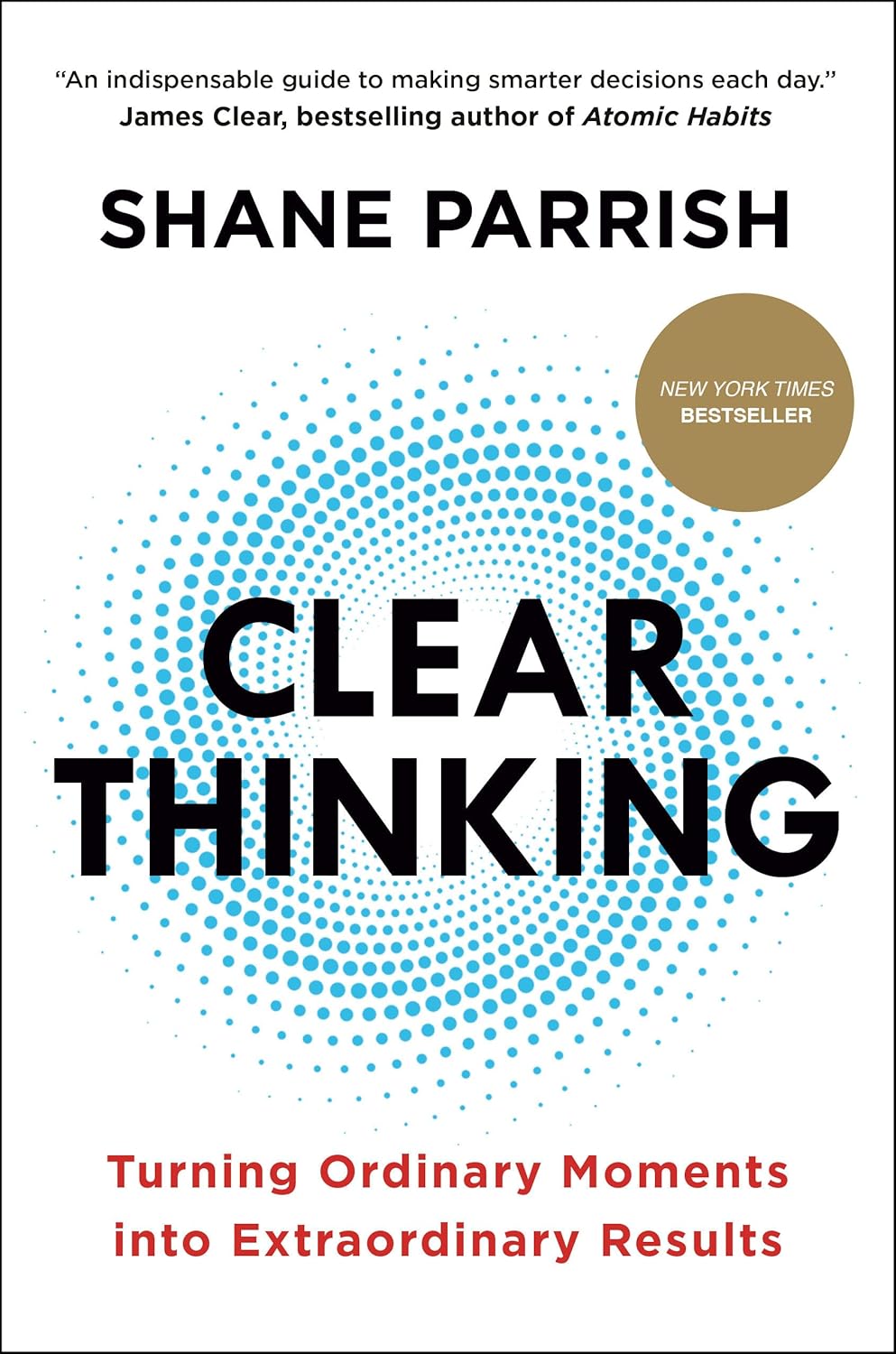
The book is a manual for the moments before a decision. Four defaults — emotion, ego, social, inertia — are described as evolved reflexes that fire before you know a choice is even on the table. Part 2 builds counterweights, Part 3 installs safeguards, Part 4 lays out a procedure for the decisions themselves, and Part 5 asks what any of it is for.
The diagnostic claim is sharper than the genre usually manages. “In most ordinary moments the situation thinks for us.” Other decision books, Parrish argues, assume the trouble is reasoning badly; his claim is that the trouble is not registering that reasoning was called for. Nothing taps you on the shoulder. The retaliating comment is out of your mouth before you’ve noticed a fork existed.
If that’s right, the remedy can’t be effort, and Parrish follows the logic where many writers in this line refuse to. He says outright that almost everyone eventually loses the fight with willpower, and that people with good defaults usually have good environments rather than better character. The conclusion states the principle cleanly: “It’s about designing systems when you’re at your best that work for you when you’re at your worst.” Part 3 does the honest work of applying it: rules fixed in advance, enforced delays, someone given standing permission to tell you no.
Then comes Part 5.
Parrish has said since the preface that this is the question the rest of the book serves — knowing how to get what you want is worth nothing if the wanting is wrong. The conclusion says it again, more firmly. And the method offered is a thought experiment. Picture yourself at ninety. Picture the funeral, and what people will say once you can’t reply. Sit with the distance between that and this. Which is introspection, consulting the same interior that Part 1 spent eighty pages establishing as a compromised witness. Parrish then writes the sentence that gave me pause: “Deep down, you already know what to do, you just need to follow your own advice.”
The obvious defence is that quiet reflection at a desk is not reaction in a meeting, and that the exercise is itself a way of making space. That holds, up to a point. But every other safeguard in the book is built so something outside you can check it — a rule you wrote down before you had a stake, a colleague authorised to object, a delay that lets evidence arrive. Your ninety-year-old self is not an outside party. He agrees with you. Notice what he returns when Parrish runs the experiment on himself: eat better, sleep more, exercise, put the phone away around the kids, sit on the couch after school and hear about the day. All good. All things Parrish plainly believed before he asked. An instrument that hands back what you already endorse has not opened any space between you and your defaults. It has given them a hearing in flattering light.
The distribution of pages says something similar. Part 4, on executing decisions, runs to roughly forty-five percent of the text. Part 5, which the conclusion insists everything else depends on, is under nine. And its material isn’t drawn from Parrish’s own apparatus at all: it’s Dickens, Seneca, and a gerontologist’s survey of what old people wish they’d known sooner. The machinery he spent four parts constructing doesn’t reach the question, so he borrows other people’s consolations to cover the last stretch.
I’m not sure the alternative exists, which complicates things. Nobody has a procedure for what to want; Aristotle didn’t, and the book quotes him admitting as much in the form of an archery metaphor that assumes the target is already visible. What bothers me is the unmarked change in confidence. Parrish is precise and testable about how to set a decision rule or run a pre-mortem, and turns general and hortatory the moment the subject is ends rather than means — wise people harmonise the parts of life, wise people know what real wealth consists of — without ever signalling that the kind of claim has changed. The reader is carried at the same speed through both.
Which brings the golfer back. Nothing in Parts 1 through 4 would have caught him. He wasn’t reacting; he was executing, patiently, across decades, toward a goal he had picked early and never reopened. By the standards of the first four parts he did it well. He is precisely the case Part 5 has to answer, and Part 5 answers by asking him to imagine himself old and see what he would regret — which is, in the end, exactly what happened to him, some while after stepping away, once there was nobody left to play with.
If you’d like to read the full book in EPUB or MOBI format, feel free to send me an email—I’d be happy to share a free copy with you. Please reach me at: thenovaleaf@gmail.com


Reviews
There are no reviews yet.