
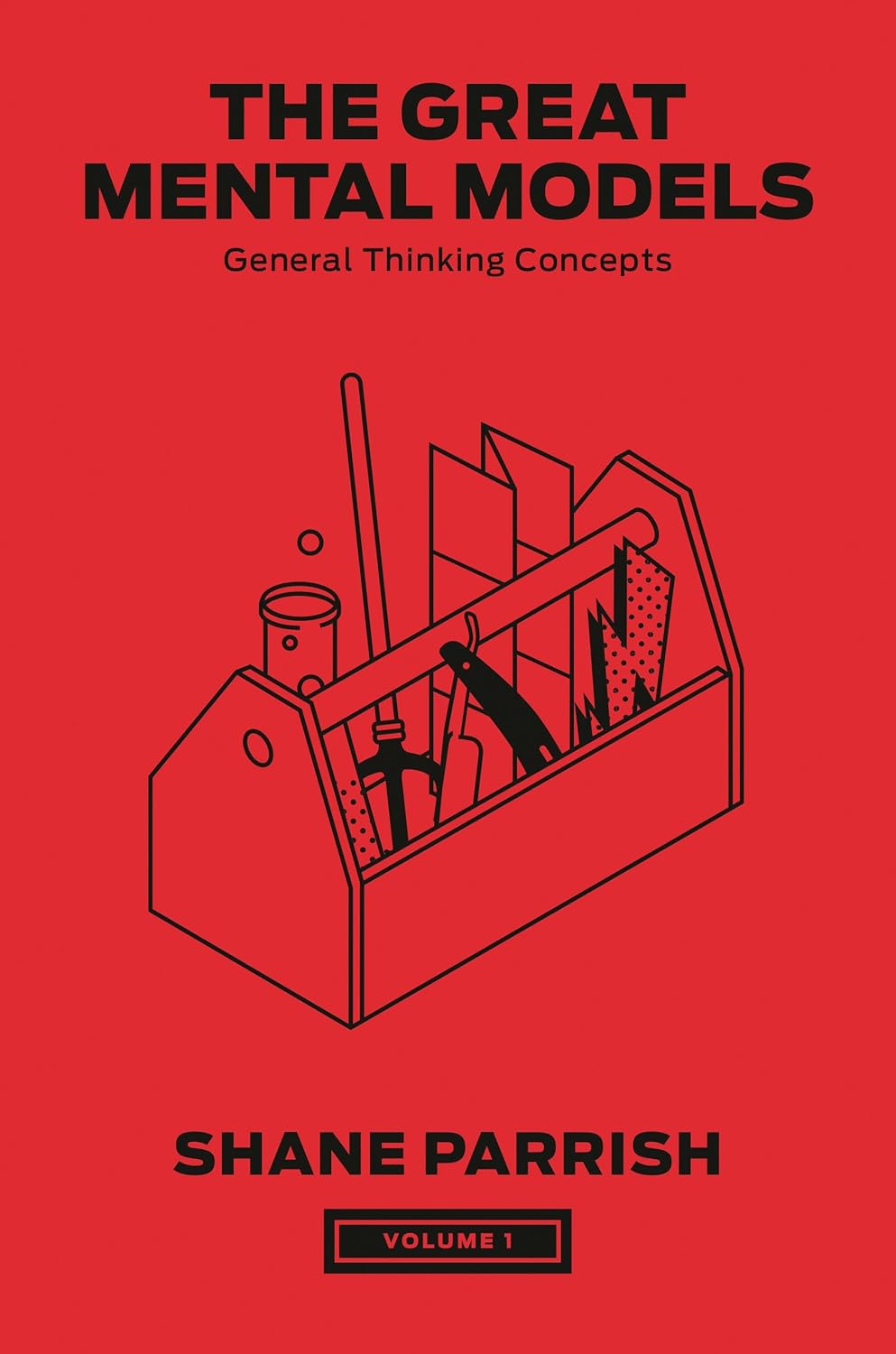
Description
Every chapter of The Great Mental Models opens with a small dossier headed The People Who Appear in this Chapter, followed by short biographies with dates and a line of context each: Korzybski, Tenzing Norgay, John Rawls. It reads like the character list at the front of a Russian novel. Notice what else it does. It seals each chapter. The people arrive, do their work, and are not heard from again.
This is Shane Parrish’s first volume of a projected five, grown out of his site Farnam Street and out of Charlie Munger’s long argument that a broad set of borrowed models beats deep expertise in one thing. Volume One collects nine general thinking concepts — the map and the territory, circle of competence, first principles, thought experiments, second-order effects, probability, inversion, and the two razors — with three shorter supporting ideas tucked between them. Each defines its model, then illustrates it: Norgay for competence, Florence Nightingale for inversion, Vera Rubin for Occam’s.
The organising image is a lattice, and Parrish is precise about what he means by it: “Exactly the same sort of pattern that graces backyards everywhere, a lattice is a series of points that connect to and reinforce each other.” The emphasis falls where it should, on the joins. The claim isn’t that the points are individually sound. It’s that they hold each other up.
So count the joins. Across the whole volume, one chapter points the reader toward the Falsifiability section, and one sidebar mentions Bayesian updating as something covered in the Probabilistic Thinking chapter. Two. A book whose case rests on interconnection gives us nine models that never meet.
The clearest instance sits in the last stretch. Occam’s Razor prefers the account with the fewest moving parts. Hanlon’s Razor, one chapter later, prefers the account that assumes the least intent, which is Occam applied to human behaviour, and Parrish comes within a word of saying so before letting it drop. Consecutive chapters. Same logical shape. No line drawn between them. If the two models sitting nearest each other on the page can’t be shown to interlock, a reader has no template for the harder work of connecting probability to competence, or inversion to second-order effects.
There’s a cost underneath this that the structure hides. Each chapter arrives with a problem already fitted to its model, so the models never compete for a case, and never lose one. Everest belongs to circle of competence. Edward Bernays belongs to inversion. The examples were chosen after the tool. You finish the book having watched nine models succeed nine times, and having never once seen two of them disagree about the same situation, which is what happens the moment you try to use them.
The book comes close to that scene in the Occam chapter, then flinches. Parrish uses dark matter as his showcase for preferring the tidier account, walks through Rubin’s observations of Andromeda, and then writes: “What is particularly interesting is that to this day no one has ever actually discovered dark matter.” He goes further, reporting that Rubin herself came to suspect the answer lay in revising our understanding of gravity. Two of his own models are in open conflict on that page — the razor that says take the account with fewer parts, the falsifiability standard that says a theory earns its keep by risking refutation — over a case where the tidier account has gone undetected for fifty years. Somebody thinking with a lattice stops here for four pages. The chapter moves on to floating black balls on a Los Angeles reservoir.
Selection is the part left undone. Parrish tells the reader to be deliberate about which model to reach for in a given situation, which is correct, and the guidance that follows is to keep a journal, record what you tried, reflect on the result. Sensible. Also the whole difficulty, handed back across the table. Learning nine tools is a weekend; knowing which one a given mess is asking for is the actual skill, and I don’t think it transmits except by watching someone choose wrongly and then correct.
I want to be fair about the constraint. This is one volume of five, and the connective work may well be what the later ones are for. But the lattice is the reason offered for reading this one. It’s in the preface, the introduction, and the publisher’s note before the copyright page. A claim made that prominently owes some demonstration inside the book that makes it.
The chapters are good on their own, and the sharpest passage in the volume belongs to somebody else. In the map chapter, Parrish brings in Elinor Ostrom’s worry about models used in public policy: that the constraints held fixed for the purpose of analysis get quietly taken as fixed in the world. “They are tools for exploration, not doctrines to force conformity.” That is a better sentence about the hazards of the mental-models project than anything the book manages in its own voice, and Parrish says plainly in the preface that none of the ideas are his.
Still, the cast lists read differently by the end. Korzybski appears once and leaves. Norgay appears once and leaves. Rubin appears once and leaves. No figure returns in a second context, no problem is looked at twice from a different side. The book’s own image describes a structure that holds because of where its lines cross. What’s on the page is a very well-made fence.
If you’d like to read the full book in EPUB or MOBI format, feel free to send me an email—I’d be happy to share a free copy with you. Please reach me at: thenovaleaf@gmail.com


Reviews
There are no reviews yet.