
Description
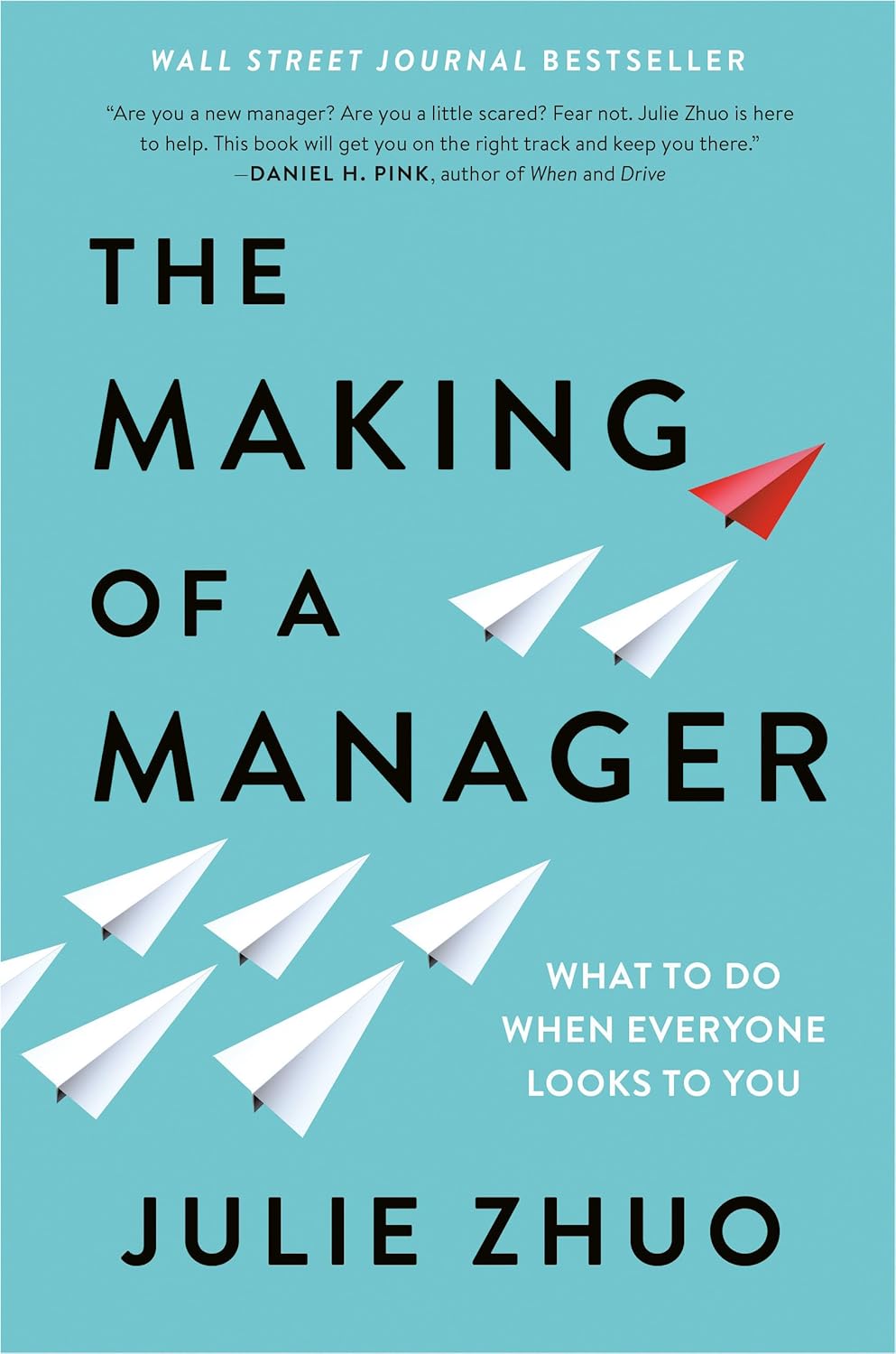
There’s a genre of business book that functions less as literature than as corporate sacrament — a laying-on of hands for the newly anointed middle manager. Julie Zhuo’s The Making of a Manager belongs squarely to this tradition, yet it possesses a disarming self-awareness that lifts it, intermittently, above the usual Silicon Valley catechism. Zhuo was twenty-five when Facebook handed her a team to lead. She had no training, no particular instinct for it, and — to her credit — she doesn’t pretend otherwise.
The book is, at its core, a field guide for people who’ve been promoted before they’re ready. It covers the expected terrain: how to run meetings that don’t make everyone want to quit, how to hire without catastrophic misjudgment, how to deliver feedback that lands somewhere between cruelty and uselessness. Zhuo structures all of this around her own trajectory at one of the most consequential tech companies ever built, which gives the material a narrative spine that many management books lack entirely. You get the sense of someone thinking out loud about lessons that cost her real anxiety to learn, not recycling frameworks she picked up at a weekend seminar.
What surprised me, reading through, was the honesty of the uncertainty. Zhuo doesn’t construct herself as the protagonist who cracked the code. She’s nervous. She second-guesses. She describes the particular loneliness of being responsible for other people’s careers when you’re barely sure about your own. There’s a vulnerability here that feels unperformed, and it gives the early chapters a quality I wasn’t expecting — something close to genuine introspection. Her prose carries the caffeinated informality of her milieu (people are “kicking ass,” situations are “n00b-ish”), and that register won’t charm every reader. But beneath the slang sits a writer who’s actually trying to be precise about what confused her and why.
Still, the book’s central thesis reveals a philosophical flatness that no amount of personal candor can quite disguise. Zhuo defines the manager’s purpose with ruthless economy: to get better outcomes from a group of people working together. It’s a clean formulation, and an honest one, but it also strips away anything resembling a humanistic vision of leadership. People become inputs. The manager is an operator — ideally a multiplier, terrifyingly a diminisher. When Zhuo writes about imposter syndrome, which she does with evident feeling, the anxiety she describes isn’t really existential. It’s operational. She fears being the bottleneck, the drag coefficient on team velocity. The soul is permitted its crises, provided they’re eventually resolved in a retrospective and fed back into the system. I don’t think Zhuo is unaware of this tension, exactly. But she never pushes hard enough against it to generate real friction.

The more fundamental limitation is one of scope. Zhuo’s entire frame of reference assumes a world of headcount growth, abundant capital, and organizations racing to fill roles that didn’t exist six months ago. Her recurring metaphor — a lemonade stand scaling into a franchise — captures something real about startup dynamics, but it also exposes what the book can’t see. What about the manager navigating budget cuts? Or the one holding together a demoralized team in a company that peaked three years ago? Zhuo’s advice is meticulously calibrated for conditions of surplus, and it loses traction the moment you try to apply it to environments shaped by constraint, stasis, or decline. This isn’t a fatal flaw — every book has its intended audience — but it does make the title’s implied universality feel like overreach.
Within the territory it does survey, though, the book is genuinely useful. The chapters on feedback and on building trust have a practitioner’s specificity that more theoretical management texts often lack. Zhuo is good at breaking down moments of interpersonal difficulty into component parts without making the process feel robotic. Her advice on hiring, while clearly shaped by a world where dozens of candidates compete for every opening, contains observations about pattern-matching and bias that translate beyond the tech sector. And her willingness to name her own failures — bad hires she made, conversations she botched — lends the prescriptive passages a credibility they wouldn’t otherwise have.
Readers looking for a book that interrogates the deeper costs of corporate optimization won’t find it here. Zhuo is a participant, not a critic, and the book reads accordingly. But as a practical companion for someone suddenly responsible for other people’s work and wellbeing, written by a person who remembers what that terror feels like, The Making of a Manager earns its place on the shelf. It is a competent, occasionally affecting manual for a specific kind of professional bewilderment — and an unintentional document of what it means to build a self inside an institution that would prefer you function as a ratio.
If you’d like to read the full book in EPUB or MOBI format, feel free to send me an email—I’d be happy to share a free copy with you. Please reach me at: thenovaleaf@gmail.com


Reviews
There are no reviews yet.