

Something has gone wrong with the math of modern comfort. Our material pleasures have multiplied — high-potency cannabis, algorithmic validation, everything from pornography to productivity apps available at the swipe of a glass screen — and our misery has kept stride. We are more anxious, more depressed, more physically in pain than the conditions of our lives would seem to warrant. Anna Lembke, a psychiatrist and the medical director of Stanford Addiction Medicine, offers a biological explanation in Dopamine Nation: Finding Balance in the Age of Indulgence. The argument is blunt: our brains were built for a world of prehistoric scarcity, and we’ve aimed a firehose of reward at them.
The Science of the Seesaw
Lembke anchors her argument on a specific neuroscientific discovery: pleasure and pain are processed in overlapping regions of the brain and act as an opponent-process system. She visualizes this mechanism as a seesaw resting on a central fulcrum. When we experience something pleasurable — a hit of nicotine, a notification on Twitter, a bite of a glazed donut — the balance tips toward pleasure. Dopamine, the brain’s primary currency of reward and motivation, floods the synaptic clefts.
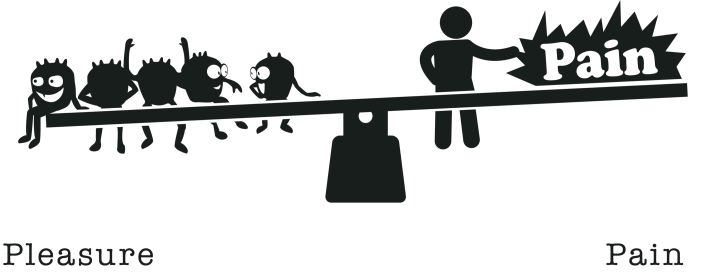
But the brain prefers equilibrium — homeostasis. To restore it, the brain mounts an equal and opposite response, and here Lembke reaches for what is probably the book’s most durable image: a squad of gremlins hopping onto the pain side of the seesaw. They jump on to weigh it down, bringing the board back to level. The catch is that the gremlins don’t hop off the moment equilibrium is reached. They linger just a little longer, tipping the balance toward pain. This is the physiological basis of the “comedown” — the restless agitation when a good movie ends, the itch to reach for a second potato chip.
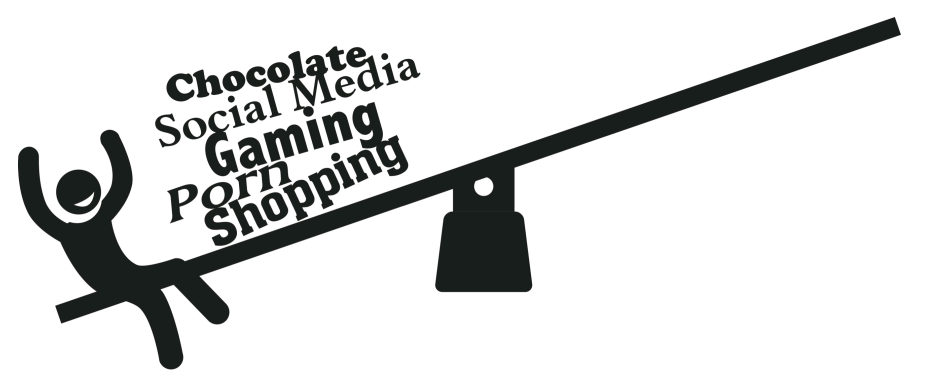
Lembke includes her own struggle with reading erotic romance novels to show how easily the trap springs shut. She found herself reading between patient sessions, bringing her Kindle to the clinic, chasing the climax of formulaic plots to escape the stress of parenting and middle age. A Stanford medical professor, sneaking chapters between appointments — it’s a brave admission, and she leans into it. She applies her own framework, throws away the e-reader, and endures the withdrawal. It works. But is a romance novel habit biologically equivalent to a heroin addiction?
If you use a high-dopamine substance long enough, the brain alters its baseline. The gremlins multiply. They bring tents and sleeping bags and set up a permanent camp on the pain side of the balance. Now, you need the drug not to feel high, but merely to feel normal. Lembke describes patients — from Jacob, a man whose compulsion for electrically stimulated masturbation destroyed his marriage, to David, a college student taking massive doses of Adderall just to function — who have pushed their pleasure-pain balance into a chronic dopamine deficit state. Hedonism, pursued relentlessly, results in anhedonia.
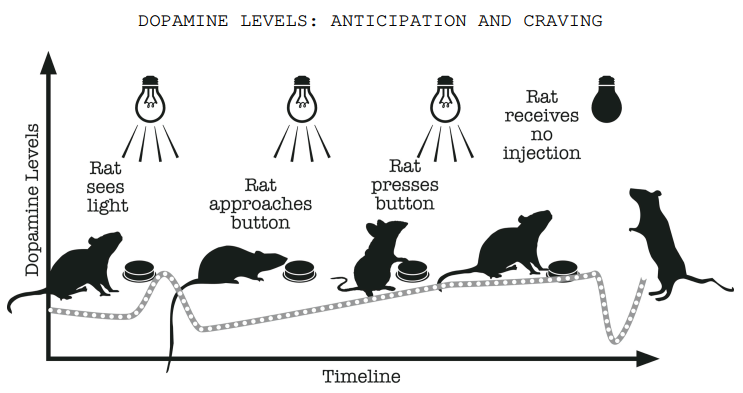
What makes the cycle hardest to break isn’t the reward itself but the anticipation. Relying on the work of neuroscientist Nora Volkow and others, Lembke details how the brain learns to associate environmental cues with the delivery of a reward. Once this Pavlovian conditioning occurs, dopamine spikes in response to the cue, not just the drug. What follows the spike is a sudden, transient drop in dopamine levels below baseline — a micro-deficit we experience as craving, the biological engine of wanting. You hear the ping of a text message, and your dopamine dips, creating an itch that can only be scratched by picking up the phone. If the reward is delivered, dopamine surges. If it is withheld, the deficit deepens, plunging you into frustration.
Abstinence and Its Discontents
To escape this cycle, Lembke prescribes a period of abstinence. She structures her clinical approach around the acronym DOPAMINE (Data, Objectives, Problems, Abstinence, Mindfulness, Insight, Next steps, Experiment). The linchpin is the dopamine fast — abstaining from the drug of choice for a full month so the brain can clear the gremlins from the pain side of the balance. The dopamine deficit state resolves. Homeostasis restored. As a conceptual tool, the seesaw is elegant: it gives patients a vocabulary for their suffering and a rationale for enduring withdrawal. When Lembke tells a teenager addicted to vaping cannabis that she must sit through a month of heightened anxiety before her baseline resets, the gremlin metaphor provides a container for that distress, something to point at that isn’t the self.
Map this mechanical analogy onto the messy reality of human behavior, though, and the edges fray. Lembke’s framework assumes a kind of neurochemical egalitarianism — that we all start with a level balance. She acknowledges briefly that people with trauma or co-occurring psychiatric disorders might start already tilted toward pain. Yet the primary intervention remains the same: remove the high-dopamine stimulus. The approach flirts with a reductionism that views almost all psychological distress through the lens of consumption. If a patient is depressed, the culprit is likely the phone, the weed, or the junk food. Abstinence becomes a diagnostic test. If the depression lifts after a month, it was a dopamine deficit. If it doesn’t, then, and only then, might we consider underlying pathology.
There’s something appealing about this for a culture exhausted by the medicalization of everyday sadness. Lembke rightly criticizes the pharmaceutical industry’s overprescription of psychotropic medications, noting that we’ve pathologized normal human suffering. We take Adderall for distraction, Xanax for anxiety, and Ambien for insomnia, often compounding the very problems we seek to cure. By framing these pills as just another set of weights on the pleasure side of the balance, she exposes the hypocrisy of a medical system that treats the symptoms of a hyper-indulgent society with more indulgence.
Lembke argues the mechanism is the same for all compulsive behaviors, only the potency differs. But flattening every compulsion into a single neurochemical model means losing the specific context that gives those behaviors meaning. A young man named Chris, who struggled with intense social isolation and suicidal ideation, finds stability on buprenorphine (a synthetic opioid). Lembke questions whether the medication is merely a crutch that prevents him from experiencing the friction of real life — whether he’s missing out on the full spectrum of human emotion. Chris is clear. The medication keeps him alive. I kept circling back to this passage because it’s the moment where the dopamine balance, so tidy as a diagram, buckles under the weight of someone’s actual desperation. The mechanical model struggles to accommodate a mind that wants to end its own existence.
Self-Binding and the Pursuit of Pain
Lembke’s solution to the ubiquity of temptation is “self-binding.” Recognizing that willpower is a finite resource, she advocates for creating physical, chronological, and categorical barriers between ourselves and our vices. We lock our phones in timed safes. We restrict our media consumption to weekends. We avoid the people and places that trigger our cravings. Odysseus tying himself to the mast, updated for the age of DoorDash.
The fatal flaw is one that Lembke’s own case studies inadvertently highlight. The locks we place on our desires are only as strong as the rational mind that set them. When the dopamine deficit state takes over, the prefrontal cortex — the part of the brain responsible for long-term planning and impulse control — goes offline. We become astonishingly resourceful at bypassing our own security measures. A patient named Oscar locks his alcohol in a file cabinet and gives his wife the key, only to find himself dismantling the lock with tools from his garage the moment she leaves town. He fails to open the drawer, but his addicted brain finds a workaround. He retrieves a long plastic straw and drinks the wine without ever removing the bottle. Self-binding works best for those whose compulsions are mild enough that a slight physical friction can derail the impulse. For the truly afflicted, a timed safe is merely a puzzle waiting to be solved. Chronological and categorical binding fare little better against the relentless ingenuity of the addicted mind, or the market that feeds it. You might restrict your consumption to weekends, but the brain simply stretches the definition of the weekend. You might decide to eat only gluten-free foods as a way to categorically eliminate high-calorie baked goods, but the food industry swiftly responds by engineering gluten-free cookies, cakes, and pastas that are just as hyper-palatable as their wheat-based ancestors. The environment morphs to bypass the restriction.
Because avoiding the stimulus is often impossible and self-binding is inherently fragile, Lembke introduces a counterintuitive alternative. If the pursuit of pleasure inevitably summons the pain gremlins to the seesaw, perhaps the sequence can be reversed. Perhaps the deliberate pursuit of pain can yield a sustainable return of pleasure. She grounds this in the science of hormesis, the biological phenomenon wherein exposure to mild or moderate stressors makes an organism more resilient. Nematode worms exposed to high heat live longer. Fruit flies spun in a centrifuge become more agile. In humans, the most obvious application is exercise, which is toxic to cells in the immediate term but prompts a cascade of reparative, mood-boosting neurochemicals in the aftermath.
Lembke’s patients take the principle to extremes. Michael, a wealthy real estate developer recovering from cocaine and alcohol addiction, discovers that immersing himself in ice-cold water provides a euphoric rush. He buys a commercial meat freezer, fills it with water, and installs a motor to keep the water circulating so his body heat cannot form a protective thermal layer. He sits in water chilled to the low thirties every morning. The shock to his system causes his plasma dopamine and norepinephrine concentrations to spike massively, remaining elevated for hours after he steps out of the tub. By pressing heavily on the pain side of the balance, he triggers the brain’s homeostatic reflex. The gremlins hop onto the pleasure side to compensate for the freezing water, and they linger there long after he is dry.
It’s hard to read about Michael’s custom-built ice trough without sensing a substitution — one pathology swapped for another with better branding. Lembke is aware of this danger. She notes that people can become addicted to pain just as easily as pleasure, citing the dysphoria experienced by overtraining endurance athletes and the adrenaline dependency of free-solo climbers like Alex Honnold. The biological ledger demands payment, and you can pay upfront with physical discomfort, or pay later with a dopamine deficit.
Viewing human experience as a strict thermodynamic accounting system, though, feels claustrophobic. It shrinks the search for meaning to a management of neurochemical ratios. The asceticism of the cold plunge has become a well-documented status symbol for the Silicon Valley elite — a demographic heavily represented in Lembke’s clinic — who track their heart rates, optimize their fasting windows, and quantify their distress on a scale of one to one hundred. I’ve sat in enough San Francisco coffee shops to recognize the type: pain as productivity hack, suffering as optimization. When discomfort is pursued merely for the neurochemical afterglow, it’s severed from any moral or communal purpose. Just another isolated transaction.
Lembke seems to sense this limitation herself, and the book’s final third shifts accordingly — from the synaptic to the sociological, from individual neurochemistry to radical honesty and prosocial shame.
Honesty as Neurochemistry
Lying, Lembke observes, is a natural human capacity, likely evolved to help us compete for scarce resources. But in a modern environment of abundance, lying creates a psychological “scarcity mindset.” When we hide our habits, curate a false self on social media, or tell minor untruths to avoid conflict, we signal to our own brains that the world is a dangerous, unpredictable place. This anxiety feeds the urge to self-medicate. Honesty forces us to inhabit reality. Lembke points to an experiment demonstrating that stimulating the prefrontal cortex with an electrical current makes subjects less likely to lie for financial gain. She hypothesizes that the inverse is also true: the daily practice of telling the truth strengthens the prefrontal cortex, enhancing our ability to delay gratification and resist impulsive urges.
The right kind of social friction is what keeps this honesty operational over time. Lembke makes a sharp distinction between destructive shame, which isolates the transgressor and fuels further use, and prosocial shame, which holds the individual accountable while keeping them firmly within the group. She uses Alcoholics Anonymous to illustrate. Drawing on the work of behavioral economist Laurence Iannaccone, she explains that AA operates by generating “club goods.” The value of the group depends entirely on the active, honest participation of its members. To prevent “free riders” from diluting the group’s efficacy, AA demands high-cost sacrifices: public admission of character defects, the immediate resetting of a sobriety date after even the slightest relapse, the rigid adherence to the Twelve Steps. The strictness is the source of its power. When a member admits a failure, the group doesn’t banish them. It absorbs the confession, validates the shared struggle, and provides a clear pathway for making amends. In an era where any form of social judgment is rapidly labeled as toxic, Lembke insists that feeling bad about our bad behavior is an essential feature of a healthy community — that we need the friction of other people’s expectations to keep our own rationalizations in check.

As the book broadens to encompass these societal dynamics, a glaring tension opens up between the scale of the problem and the scale of the proposed solutions.
Lembke repeatedly references the historian David Courtwright, whose concept of “limbic capitalism” describes how global industries have weaponized our neural circuitry for profit. She notes that the food industry engineers products to hit the exact bliss point of salt, sugar, and fat. The pharmaceutical industry’s role in flooding the United States with high-potency opioids gets its due. She cites the economists Anne Case and Angus Deaton, who trace the skyrocketing rates of addiction and suicide among the working class to the collapse of meaningful employment and the hollowing out of the American dream. Lembke knows, in other words, that the dopamine flood is not a natural disaster. It’s a business model.
Yet her prescriptions remain stubbornly, almost exclusively, individualistic. If the entire global economy is engineered to extract our attention and money via our dopamine receptors, advising individuals to take cold showers, lock up their smartphones, and practice radical honesty feels like advising people to combat climate change by holding their breath. This is the inherent trap of the science-backed self-help genre — the format demands actionable takeaways, which requires the author to shrink systemic crises into personal habits. Lembke’s clinical anecdotes skew heavily toward affluent professionals: surgeons, real estate developers, software engineers, Stanford students. These are people who possess the material security and leisure time to treat their neurochemistry as a self-improvement project. When a gig worker is exhausted, underpaid, and reliant on cheap fast food and free digital entertainment just to endure the week, telling them to embrace the pain of an ice bath borders on the absurd. Their lives are already saturated with unchosen friction. By focusing so intently on the internal mechanics of the brain, the book inadvertently absolves the external environment. If addiction is primarily a matter of a disrupted pleasure-pain balance, then the responsibility rests entirely on the individual to restore that balance. The structural forces that profit from our neurobiological vulnerabilities go largely unchallenged. We’re taught how to survive in the casino, but never to question who built it or why the doors lock from the outside.
There’s a quiet tragedy in this adaptation. The ultimate goal of the dopamine fast isn’t to change the world but to endure it more efficiently. Lembke suggests that by resetting our reward pathways, we can eventually find joy in simpler, less potent pleasures: a walk in the woods, a conversation with a friend, the unadorned reality of the present moment. The mindfulness traditions of Buddhism, the stoicism of the ancients. But the ancients were not fighting against an algorithmic feed designed by thousands of engineers to hijack their attention. They were not living in an ecosystem where every basic human drive — for connection, for sustenance, for sex, for novelty — has been commodified and sold back to them in concentrated, synthetic doses.
Dopamine Nation gives us a clear, unsentimental vocabulary for understanding why we feel so terrible in an age of such extreme comfort. The seesaw metaphor, for all its mechanical simplicity, works — it makes the hidden costs of daily indulgence legible. Lembke writes with real compassion for her patients and a refreshing absence of ego about her own vulnerabilities. She forces the reader to look closely at their own habits, to identify the subtle ways they’re fleeing from the friction of existence. The curious professional, toggling between productivity apps and social media feeds, will find practical value in her framework for dopamine fasting. But the book stops at the edge of the individual skull. It teaches us how to govern our own synapses while Oscar drinks wine through a plastic straw, outwitting the lock his wife set, outwitting the lock he set on himself.
If you’d like to read the full book in EPUB or MOBI format, feel free to send me an email—I’d be happy to share a free copy with you. Please reach me at: thenovaleaf@gmail.com