

We are a culture obsessed with the podium, yet paralyzed by the pressure required to reach it. The modern professional — Olympic athlete, Silicon Valley founder, mid-level manager sweating through a quarterly review — operates under a crushing mandate to optimize, achieve, and conquer. We want the gold medal, the corner office, the venture capital funding. We tie our identities to these external markers of victory. Jim Murphy, a former minor league baseball player turned high-performance coach, looks at this relentless striving and diagnoses a terminal illness he calls the “affluenza virus.” In Inner Excellence: Train Your Mind for Extraordinary Performance and the Best Possible Life, Murphy argues that our fixation on winning is precisely what prevents us from achieving true greatness. If we want to perform at our absolute peak, we must surrender our attachment to the outcome.
Murphy’s project splices sports psychology, cognitive behavioral therapy, and Eastern mysticism into something that reads like a mental operating system for the anxiously ambitious. He borrows heavily from Abraham Maslow, Viktor Frankl, and samurai philosophy, assembling a framework designed to inoculate high achievers against the paralyzing effects of pressure.
The Critic, the Monkey, and the Trap
The root of all performance anxiety, Murphy posits, is self-centeredness. When we step up to the plate or walk into a boardroom, our natural inclination is to worry about how we will look, whether we will fail, and what others will think. This self-consciousness awakens three internal adversaries — the Critic, delivering a negative verdict on every action; the Monkey Mind, cluttering the brain with anxious, future-oriented chatter; and the Trickster, the deceptive internal narrative that whispers lies about our inadequacy and urges us to self-protect.
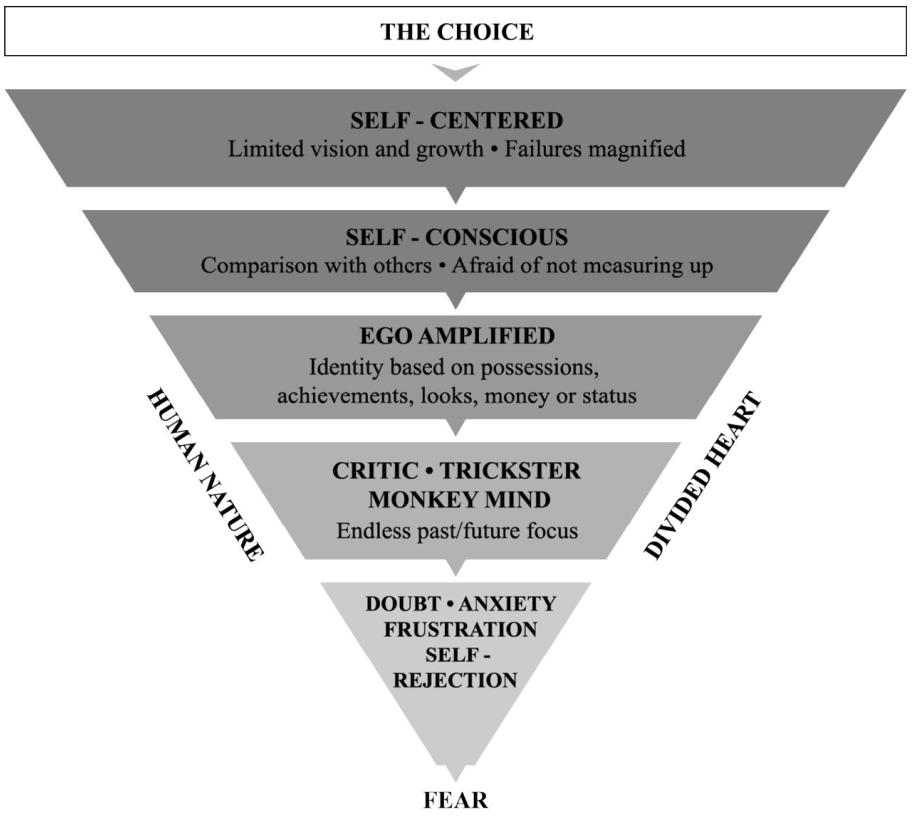
The ego takes the wheel. Because it derives its entire identity from external validation — possessions, achievements, looks, money, and status — it is perpetually insecure. It cannot control the future, yet its survival depends on future victories. This breeds a desperate neediness that chokes off the very state of flow required to win. The pursuit of excellence curdles into a flight from humiliation, and the athlete becomes so terrified of the mistake that the mistake becomes inevitable.
To counter this, Murphy introduces the concept of zoe, a Greek word he translates as “absolute fullness of life.” The performer must shift their highest goal from outward success to internal mastery. Love — leading with the heart, pursuing a purpose beyond oneself. Wisdom — expanding vision beyond immediate circumstances. Courage — remaining fully present in the face of intense adversity.
If you can replace the fear of losing with an unconditional love for the process, the opponent, and the challenge itself, you enter what Murphy calls “resonance.” The physical body and the mind align. The performance becomes effortless.
Frozen Water, Frozen Throws
Murphy illustrates this transition through a series of high-stakes case studies. Lewis Gordon Pugh swam a kilometer in the freezing waters of the North Pole. Pugh failed his initial test swims because he was consumed by the very rational fear of death — the freezing water triggered an overwhelming panic response. He only succeeded when his coach instructed him to stop thinking about the kilometer and instead focus on the flags of his international crew planted every hundred meters. Pugh shifted his focus from his own survival to a purpose beyond himself — highlighting global warming and honoring his team. By abandoning his ego, he found the courage to endure the freezing water.
Then there is the curious phenomenon of the “yips,” which Murphy reframes not as a mechanical failure but as the subconscious mind working perfectly to protect the ego. When Los Angeles Dodgers second baseman Steve Sax suddenly lost the ability to make a routine throw to first base, his career nearly ended. Murphy’s explanation is clean: Sax’s subconscious had linked the act of throwing to the intense emotional pain of public failure. To protect him from further humiliation, the brain simply shut down the motor function.
The cure is not endless mechanical repetition. It is reprogramming the subconscious to detach the action from the fear of social rejection, and Murphy offers a specific toolkit for this — a visualization technique he calls the “Hollywood Helper.” The performer imagines sitting in a movie theater, watching a black-and-white film of their past failure. They float up to the projection booth, distancing themselves from the emotion of the event. They play the film backward, fast-forward, and eventually step into the movie, rewriting the ending with a feeling of calm and confidence anchored to a physical trigger — the smell of peppermint, the clenching of a fist.
This is pure Neuro-Linguistic Programming, a psychological approach that treats the brain like a programmable machine. It is highly practical, and in theory it should work — if the brain cannot distinguish between a vividly imagined event and a real one, a premise neuroplasticity supports, then the internal script can simply be rewritten.
The Sacred and the Synthetic
But the sterile mechanics of the Hollywood Helper — the floating to the projection booth, the film run backward — sit in awkward proximity to Murphy’s loftier language of soul, spirit, and unconditional love. We are asked to view ourselves as spiritual beings seeking zoe, yet the prescribed method is a software patch applied directly to the subconscious.
And this is the dangling thread of the book. Murphy asserts that the pursuit of happiness is a grand mistake. We should not seek comfort. We should seek suffering, because suffering burns away the ego and produces perseverance. He praises the grueling, sleep-deprived misery of Navy SEAL Hell Week and the agonizing physical toll of climbing Mount Everest. Suffering, in Murphy’s framework, is a purifying fire.

If suffering is so vital to the death of the ego, why do we need the “Hollywood Helper” to digitally erase the emotional pain of a bad baseball throw? If failure is the ultimate teacher, why are we rushing to rewrite the memory of it so we never have to feel its sting again? Murphy wants us to embrace the pain of the present moment, but he gives us the tools to anesthetize the pain of the past.
The same split runs through his treatment of competition. He asks the elite competitor to perform a psychological sleight of hand: train obsessively, sacrifice your comfort, push your body to the absolute limit — all while maintaining a monastic detachment from the result. Want to win enough to bleed for it, but care so little about the trophy that you feel equal joy if your opponent takes it home.
He cites martial artist Georges St. Pierre, who prayed for his opponents before stepping into the octagon to physically batter them. The instruction is to “love your opponent” because they are the necessary friction for your own self-actualization, your partner in the dance. This sounds beautiful in a seminar. It borders on the absurd in a cage fight.
Whether a person can truly decouple the primal, aggressive drive required to physically dominate another human being from the ego’s desire for supremacy is a question Murphy never quite answers head-on. He points to the samurai, who meditated on their own death daily so they could fight without fear of losing their lives. The samurai lived by a code of honor, placing virtue above material reward. Yet they were also fiercely protective of their social standing — a public insult could provoke a duel to the death. Their detachment from life was entirely dependent on their attachment to their reputation. The ego was not absent; it was simply wearing a different mask.
The demand to simultaneously conquer the world and renounce it sits at the center of the high-performance industry, not just Murphy’s corner of it. He wants his readers to achieve extraordinary, quantifiable results — a Super Bowl ring, a Fortune 500 CEO title — by pretending they do not care about them. He calls this the “double win.” You focus entirely on the process of giving your best effort, and the results take care of themselves. It’s an elegant formulation, the kind that holds up well in a keynote and starts to wobble the moment you test it against a contract year or a layoff cycle.
Engineering the Soul
The methodology for achieving this detachment relies heavily on “state control.” Drawing on the work of Dr. Jim Loehr and Dr. B.J. Fogg, Murphy argues that we are not at the mercy of our emotions — we can engineer our internal environment to produce the precise emotional frequency required for peak execution. He offers a suite of centering exercises, from box breathing to the “GPS Tool” (Gratitude, Presence, Showtime), designed to reboot the nervous system when the Monkey Mind begins to chatter.
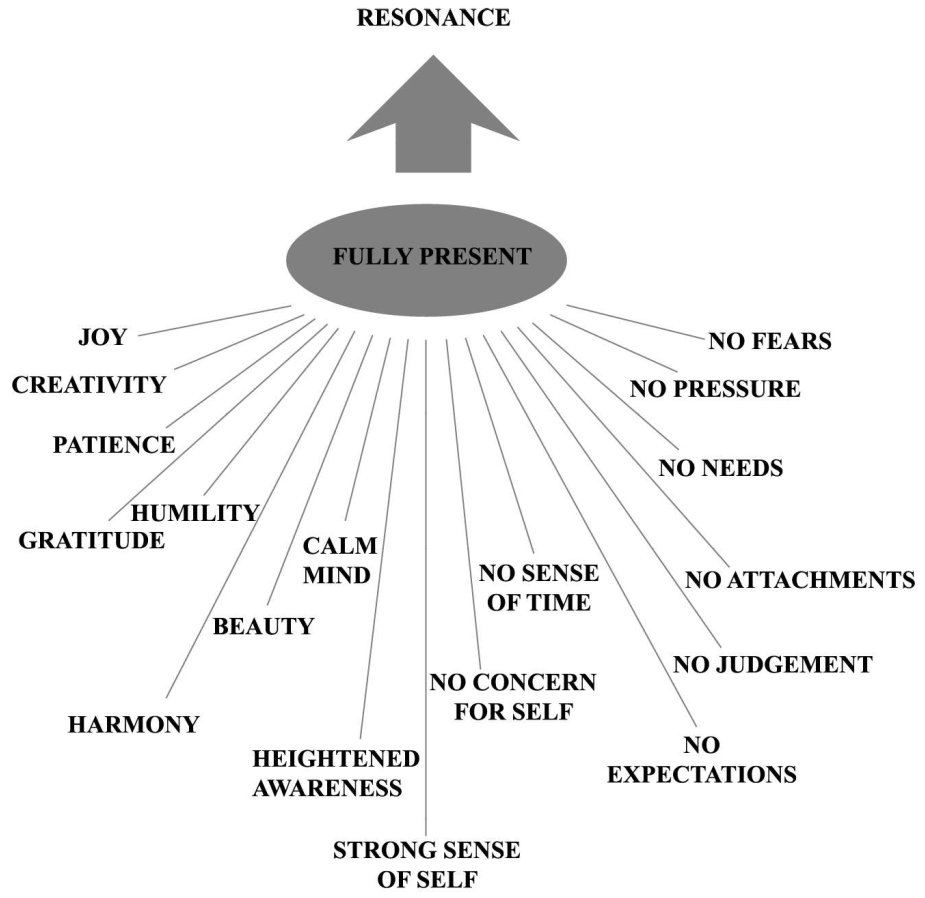
The instructions are highly prescriptive: ruthlessly eliminate “hurry sickness” from your life, recognizing that rushing is a symptom of a disordered heart; practice “soft focus” between moments of intense exertion, using peripheral vision to calm the brain’s beta waves; anchor positive feelings to physical sensations so you can summon confidence on demand. There is undeniable utility in these practices. Anyone who has ever frozen during a public speaking engagement or choked on a golf course — I have done both, within the same calendar year — knows the raw panic of the ego seizing control. Murphy’s tools offer a practical way to short-circuit that physiological response. By forcing the brain to focus on the breath or the physical sensation of the present moment, the performer starves the Critic of the oxygen it needs to spiral.
A distinctly modern irony hums underneath all of this. We are instructed to achieve a state of spiritual surrender through a regimen of hyper-vigilant psychological management. Monitor your thoughts constantly, snapping a rubber band against your wrist whenever a negative idea surfaces. Curate your physical environment to ensure you are only exposed to empowering stimuli. Visualize your success in vivid, multi-sensory detail, scripting the post-game interview before the season even begins.
This is not the effortless flow of the Tao. It is the strenuous labor of the modern knowledge worker, applying the principles of algorithmic optimization to the human soul. The ego is not truly dissolved; it is simply reassigned from the task of winning the game to the task of managing the mind. And this matters because the spiritual vocabulary Murphy employs — zoe, resonance, love — implies a kind of dissolution of the self that the practice never quite delivers. The performer who spends four hours a day monitoring their thought patterns, snapping rubber bands, and narrating their own subconscious is not less self-absorbed than the one obsessing over box scores. They are self-absorbed in a more flattering direction. The samurai from earlier come to mind again — their ego wearing a different mask, calling itself discipline.
The Paradox of Letting Go
The tension sharpens around affirmations. Murphy instructs the reader to repeat positive statements about their future self as if they were already true. “I am an incredible two-strike hitter,” or “I am an inspiring public speaker.” The goal is to bypass the conscious mind’s skepticism and plant these beliefs directly into the subconscious, which will then work tirelessly to make them a reality.
The contradiction is sharpest here: if the ultimate goal of Inner Excellence is to achieve zoe — a state of absolute fullness of life independent of external circumstances — then programming the subconscious to care so deeply about hitting a baseball or giving a speech works against the premise. The logic of true surrender leaves no room for convincing ourselves we are destined for greatness.
The answer, perhaps, lies in the specific demographic Murphy is addressing. His clients are not monks seeking enlightenment in a Himalayan cave. They are elite competitors operating in high-stakes environments where failure has significant financial and social consequences. They cannot afford the luxury of true detachment. They must find a way to care intensely about the result without being destroyed by it.
Every major voice in sports psychology has wrestled with this same paradox. Timothy Gallwey (The Inner Game of Tennis) resolved it by splitting the mind into the judging Self 1 and the executing Self 2; Ryan Holiday, drawing on Stoic philosophy, reframed adversity as the raw material for growth.
Murphy’s Spiritual Wager
Murphy’s contribution is to raise this psychological management into a spiritual imperative. He merges the cognitive behavioral techniques of sports psychology with the moral vocabulary of Christian theology and Eastern philosophy, quoting C.S. Lewis on the dangers of pride and Shunryu Suzuki on the perils of the “best horse.” He argues that true mental toughness requires a “purpose beyond self,” a mission that serves the greater good. The eclecticism is dizzying at times — Lewis and Suzuki occupy very different intellectual continents — but Murphy treats them as tributaries feeding the same river.
This moral framing gives Inner Excellence a depth that many high-performance manuals lack. It acknowledges that the relentless pursuit of external validation is not just psychologically exhausting; it is spiritually bankrupt. When Joe Ehrmann, the former NFL player, realizes that the ladder of success he spent his life climbing was leaning against the wrong building, he articulates something that most self-help books cannot bring themselves to say plainly — that the game itself might not be worth winning.
The application of this spiritual framework to the mechanics of elite competition, though, can feel strained. When Murphy advises a PGA golfer to focus on “loving the opponent” rather than winning the tournament, the question isn’t whether it’s noble. The question is whether it’s honest — whether the golfer truly loves the opponent or “loving the opponent” is simply the most effective psychological strategy for quieting the ego and sinking the putt, the selflessness a lived reality or a sophisticated instrument deployed to achieve the very success it claims to renounce.
Murphy seems aware of this, acknowledging that the pursuit of self-mastery is “in a way\… very selfish because it has by far the greatest personal rewards.” He argues that the motivation ultimately matters less than the result. If focusing on the process and serving others allows the athlete to perform with freedom and joy, the psychological mechanics of how they got there are secondary.
Drawing on the examples of coaches like John Wooden and Phil Jackson, Murphy argues that extraordinary leaders do not focus on beating the competition. They focus on creating a culture of self-mastery and personal growth, redefining success as the effort to become the best version of oneself. This aligns with what Jim Collins found in Good to Great — that the most successful companies are not obsessed with their rivals but with their own internal standards of excellence. By shifting the focus from external comparison to internal development, leaders can create a sense of psychological safety that encourages risk-taking and innovation. I spent two years working under a department head who ran his team this way — obsessed with internal standards, almost comically indifferent to what competitors were doing — and it produced a strange, low-grade arrogance that masqueraded as humility.
Which is exactly the shadow Murphy can’t quite shake. The leader who refuses to scout the opposing team, as Wooden famously did, is making a statement about his own superiority. He is saying, in effect, “We are so good that we do not need to care what you do.” What looks like humility is the ego sublimated into the collective identity of the team.
After the Arena
The book asks the reader to engage in a constant, exhausting battle against their own nature. Pursue greatness with obsessive dedication, yet remain entirely indifferent to the outcome. Engineer your internal state with ruthless precision, yet surrender all illusion of control. And through it all, seek a purpose beyond yourself while measuring your success by your own internal sense of peace. It is a high-wire act of psychological balancing, and it is easy to see why so many of Murphy’s clients experience transformations. When the ego is finally silenced, the relief must be immense — the burden of constant comparison and judgment lifted, the performer free to simply execute.
But one cannot help wondering whether this state of “resonance” is sustainable outside the controlled environment of the athletic arena or the corporate retreat. The tools Murphy provides — box breathing, visualizations, the rubber band snapping — are designed for moments of acute pressure. They are emergency interventions for the anxious mind.
The question the book leaves unexamined is what happens after. The athlete retires, the CEO steps down, the defining challenge of a life is removed. If the entire spiritual architecture has been built around the pursuit of peak performance, the quiet, unstructured reality of ordinary existence becomes the one arena it was never designed for.
Murphy suggests that the principles of Inner Excellence apply equally to everyday life, that the pursuit of zoe is not limited to the playing field but is a lifelong journey of self-discovery and service to others. Yet the examples he relies on — the Olympic swimmers, the fighter pilots, the Hall of Fame coaches — are all defined by their extraordinary external achievements. The book implicitly reinforces the very hierarchy of success it claims to dismantle.
This is the paradox of the high-performance genre. It promises to liberate us from the tyranny of the outcome, but it uses the outcome as the ultimate proof of its efficacy. We are told that winning does not matter, but the stories we are given are almost exclusively stories of people who won.
For the professional seeking a practical toolkit for managing anxiety and improving focus, Inner Excellence offers a wealth of actionable advice. The cognitive behavioral techniques are sound, the centering exercises are well-designed, and the emphasis on process over outcome is a necessary corrective to the toxic perfectionism of modern work culture. The reader who diligently applies Murphy’s exercises will likely experience a significant reduction in stress and a corresponding lift in performance.
The book’s loftier spiritual claims, however, deserve scrutiny. The promise of “absolute fullness of life” through psychological engineering is a seductive illusion. The ego cannot be permanently hacked, and the fear of failure cannot be entirely erased by snapping a rubber band against your wrist. True resilience requires the capacity to sit with discomfort without immediately trying to optimize it — the willingness to experience the messy, unscripted reality of human existence without retreating into the sterile sanctuary of the “simple mind.” Joe Ehrmann’s ladder, leaning against the wrong building after a lifetime of climbing, may be the most honest image in the book — not because Murphy lingers on it, but because he doesn’t.
If you’d like to read the full book in EPUB or MOBI format, feel free to send me an email—I’d be happy to share a free copy with you. Please reach me at: thenovaleaf@gmail.com