

The Anatomy of Professional Vertigo
There is a specific, quiet terror that stalks the cognitive elite somewhere around the middle of their fourth decade. It does not announce itself with a dramatic failure or a sudden firing. It arrives, instead, as a creeping friction. The mental leaps that once felt effortless begin to require a running start. The ability to hold six competing variables in working memory slips to five, then four. The raw processing speed that propelled the young analyst, the junior partner, or the newly minted tenure-track professor past their peers starts to drag.
Arthur C. Brooks knows this terror intimately. In From Strength to Strength: Finding Success, Happiness, and Deep Purpose in the Second Half of Life, the social scientist and former president of the American Enterprise Institute turns his analytical apparatus inward, investigating the inevitable decay of his own professional superpowers. The book that results is a strange, compelling hybrid of cognitive psychology, Eastern philosophy, and high-end executive coaching — part autopsy of ambition, part survival manual for the aging overachiever.
Brooks opens with Darwin. Not the triumphant Darwin of the textbooks, but the old man — the one who published On the Origin of Species at fifty, fundamentally altered human understanding, and then spent his final decades in depressive stagnation, paralyzed by his inability to produce another paradigm-shifting breakthrough. He had won the ultimate intellectual lottery. He died feeling like a failure.
The diagnosis relies on a concept borrowed from the mid-twentieth-century British psychologist Raymond Cattell: the distinction between fluid and crystallized intelligence. Fluid intelligence is the province of the young — the ability to reason rapidly, think flexibly, solve novel problems without prior context. It is the raw computational power that allows a twenty-five-year-old coder to invent a new architecture or a young physicist to see a mathematical relationship her elders missed.
Its tragedy is its biological expiration date. Relying on data from Dean Keith Simonton and others, Brooks points out that in almost every profession requiring heavy cognitive lifting, peak performance occurs shockingly early. For theoretical physicists, it is often in the late twenties. For doctors, the thirties. For tech founders, the window of maximum venture-capital viability snaps shut before forty. The numbers are blunt, and Brooks does not soften them.
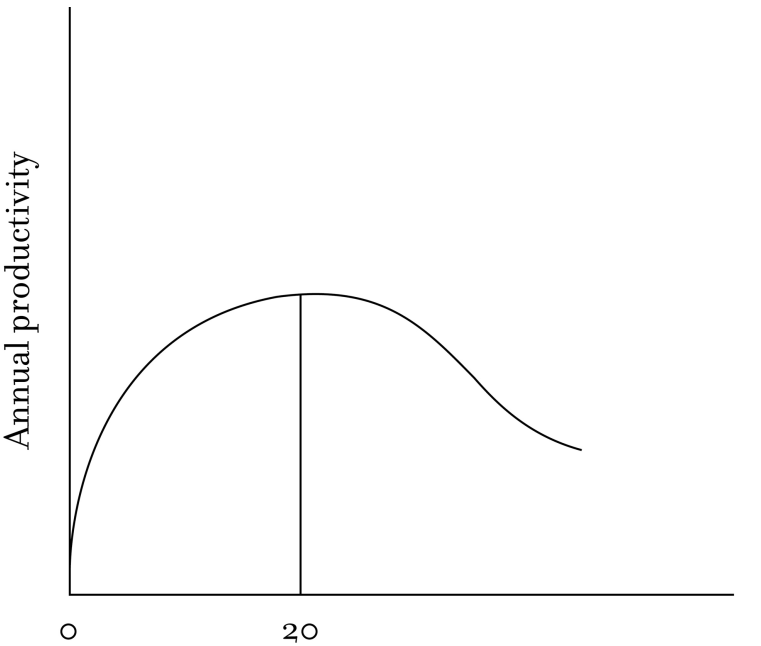
If your entire identity is predicated on being the smartest, fastest person in the room, the biological degradation of the prefrontal cortex is not just an inconvenience. It is an existential threat. Brooks captures the resulting panic through autobiography, and it’s the most convincing stretch of the book — probably because he’s no longer synthesizing research but narrating something he lived. He describes his early career as a classical French horn player, a trajectory that collapsed in his early twenties when his technique inexplicably deteriorated. He reinvented himself as a social scientist, grinding his way to the top of the Washington think-tank ecosystem, only to realize in his late forties that the familiar friction was returning. The fluid intelligence curve bends for everyone.
The Pathology of the Objectified Self
If the decline of fluid intelligence is a biological reality, the suffering it causes is a psychological choice — or at least that’s the argument. High achievers do not merely enjoy their success; they become addicted to it.
Brooks maps the neurobiology of achievement onto the mechanics of substance abuse. The dopamine hit of a promotion, a prestigious publication, or a massive financial exit operates on the same neural pathways as alcohol or gambling. The brain seeks homeostasis, so the thrill of each achievement rapidly decays, leaving the striver on a hedonic treadmill. To avoid the hangover of ordinary existence, they must secure an even larger win.
This addiction forces a grotesque mutation in how people relate to themselves. Drawing on Karl Marx’s critique of capitalism — that it reduces the worker to a mere instrument of production — Brooks pivots the lens to self-objectification. The striver becomes their own ruthless overlord, reducing their entire humanity to a two-dimensional cutout of professional prestige. It’s a strong analytic move, borrowing Marx for the executive suite, and it works better than you’d expect — partly because Brooks is clearly describing himself.
He recounts a conversation with a highly successful Wall Street executive whose life was objectively miserable. Distant marriage. Strained relationship with her children. Physical health neglected in favor of eighty-hour workweeks. When Brooks asked why she didn’t simply change her habits, she paused and replied, “Maybe I would prefer to be special rather than happy.”
That sentence is the dark, beating heart of the book. To be “special” requires constant external validation, a continuous accumulation of positional goods. But as fluid intelligence wanes, the ability to secure that validation demands increasingly unsustainable effort — running faster on a treadmill that is actively breaking down.
Brooks leans on Thomas Aquinas to categorize the idols that trap the objectified self: money, power, pleasure, and honor. For the modern knowledge worker, “honor” translates to relevance — not being respected exactly, but being talked about, consulted, sought after. The deepest fear is not poverty, but invisibility. His prescription is radical subtraction. Borrowing from Eastern artistic traditions — where a sculpture emerges not by adding clay but by removing extraneous stone — he advocates a “reverse bucket list.” Instead of accumulating more experiences, titles, and wealth, the aging striver must actively dismantle their attachments, abandoning extrinsic goals for intrinsic ones.
It is a beautiful sentiment, elegantly argued. It is also where the structural limitations of Brooks’s worldview begin to show.
The Aristocracy of the Second Curve
If fluid intelligence is the doomed rocket booster of youth, crystallized intelligence is the gentle, sustained orbit of maturity. Cattell defined it as the ability to use a stock of knowledge learned in the past — synthesis, pattern recognition, teaching, wisdom. While fluid intelligence plummets in middle age, crystallized intelligence continues to rise through the fifties, sixties, and beyond.
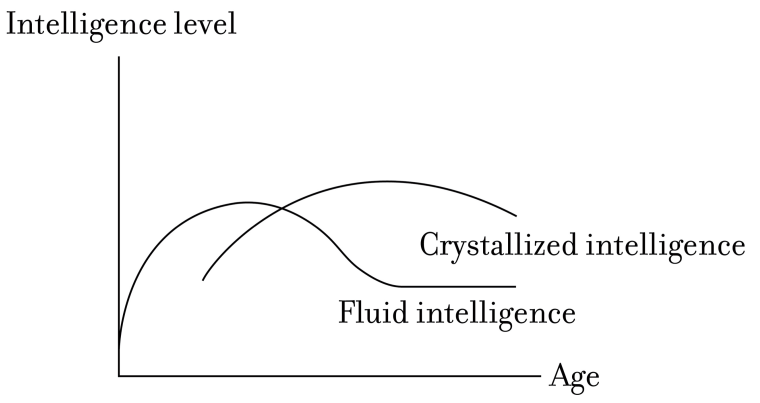
The salvation, Brooks argues, is to execute a mid-career jump from one curve to the other. Stop trying to be the innovator. Become the instructor.
He contrasts the miserable Darwin with Johann Sebastian Bach. Bach dominated the high baroque as a fluid-intelligence genius, but as musical tastes shifted toward the classical style, he was eclipsed by his own son, Carl Philipp Emanuel. Instead of raging against obsolescence, Bach pivoted. He spent his final years writing The Art of Fugue, a masterclass in instructional composition, and died surrounded by family, deeply fulfilled.
The modern version: Chip Conley, the hospitality entrepreneur who burned out in his forties, sold his company, and eventually found a new identity as an in-house mentor at Airbnb. Conley went on to found the Modern Elder Academy, a retreat in Baja California where midlife professionals learn to transition into their crystallized era. Brooks himself executed the same jump — resigning from the American Enterprise Institute for a Harvard professorship, shifting from generating original policy research to synthesizing the science of happiness.
The transition requires entering a state of “liminality,” a psychological waiting room between identities. Brooks traveled to the Indian state of Kerala to consult with a Hindu guru, Sri Nochur Venkataraman, who explained the ancient concept of the ashramas. The first stage of life is brahmacharya (learning), the second grihastha (accumulating wealth and building a career). The crisis of the modern striver is the refusal to leave grihastha. The solution: willingly entering vanaprastha, the stage of pulling back from worldly duties to focus on spirituality and wisdom.
There is a profound, unacknowledged economic reality here. The jump from the fluid to the crystallized curve, as Brooks describes it, is a luxury good.
Stepping off the treadmill of accumulation and retreating to vanaprastha — whether that takes the form of a Harvard professorship, a Baja California seminar, or a month walking the Camino de Santiago — requires an immense reservoir of prior accumulation. The striver can afford to chip away their attachments only because the boulder of their success is already massive.
For the average middle-manager, the decline of fluid intelligence does not present an opportunity to become a venerated elder dispensing wisdom to eager twenty-somethings. It presents the very real threat of being managed out of the company to save on payroll. The corporate economy does not accommodate the crystallized curve. It extracts fluid intelligence until it is depleted, then discards the husk. Brooks is writing for the hyper-successful professional who has already secured their material existence but is suffering a crisis of meaning, and within that narrow bandwidth his advice is potent. But by framing the transition as a universal psychological imperative, he obscures the extent to which “becoming a mentor” is often a privilege reserved for those who hold equity.
The Instrumentalization of Intimacy
If the professional self must be diminished, what fills the void? Brooks turns to the Harvard Study of Adult Development, the famous longitudinal study that tracked cohorts of men over eighty years to determine the predictors of late-life well-being. The conclusion, famously summarized by the study’s longtime director George Vaillant: “Happiness is love. Full stop.”
Strivers systematically underinvest in love, Brooks argues. Relationships don’t offer the immediate, measurable dopamine hits of professional success, so they get relegated to the margins of the calendar. The result: a profound loneliness at the top. He cites research showing that CEOs and lawyers are among the loneliest professionals, isolated by the power dynamics of their roles and the atrophy of their social skills.
His remedy is botanical. He introduces the concept of an “aspen grove.” A stand of aspen trees appears to be a collection of rugged individuals, but beneath the soil they share a single, massive root system. The aging striver must abandon the illusion of solitary majesty and intertwine their roots with others. It’s a lovely metaphor. Whether it can survive contact with someone who has spent thirty years pruning every relationship that didn’t yield a return — that’s the question Brooks has to answer next.
He makes a sharp distinction between “deal friends” and “real friends,” a modern translation of Aristotle’s hierarchy of friendships. Deal friends are relationships of utility, forged in the crucible of professional advancement. Real friends are relationships of intrinsic value, based on mutual affection and shared virtue. The striver’s address book is overflowing with the former, leaving them emotionally bankrupt when the professional music stops. Anyone who has ever scrolled through a thousand LinkedIn connections while feeling completely alone will recognize the inventory Brooks is describing.
The diagnosis is flawless. The prescription is where things get interesting.
When Brooks offers advice on rebuilding these atrophied relationships, the language of the management consultant creeps back in. He suggests treating relationship-building with the same methodical rigor one applies to a business strategy. He adapts a framework from the late Harvard Business School professor Clayton Christensen: “Allocate time well ahead of time,” “Do your core job,” and “Invest intelligently.” He advises the reader to literally write down a list of the people they love, identify what those people need, and execute a strategy to deliver it.
There is a jarring dissonance. We are told to abandon the instrumentalization of the self, only to apply the same mechanics to our intimacies. Can you spreadsheet your way to agape? Can you optimize your vulnerability? I kept returning to this section after finishing the book, unsure whether the dissonance is a flaw or the most honest thing in it — that for people wired this way, the spreadsheet might be the only door into the room.
Brooks acknowledges the awkwardness. He admits that for the deeply introverted or the chronically workaholic, relearning how to connect with another human being feels artificial. He points to “Men’s Sheds” in the UK and Australia, where retired men gather to do woodworking in parallel, slowly rebuilding social capacity through shared, low-stakes activity. The mechanics might be clunky, but the alternative — dying alone with a pristine résumé — is worse.
Even in his vulnerability, though, Brooks maintains a tight grip on the narrative. He advocates for “defenselessness,” urging leaders to share their weaknesses to build trust. He recounts finally admitting in a New York Times column that he earned his undergraduate degree via distance learning at age thirty, rather than at an elite institution. He braced for mockery and received a flood of supportive emails instead. His weakness became a tool for connection.
A compelling anecdote, but it subtly reframes vulnerability as a leadership tactic. Share your weakness, because it actually makes you stronger. Vulnerability with a positive ROI. What happens when a weakness can’t be leveraged into a column or a deeper bond with a subordinate? What happens when a decline is just a decline, offering no hidden strategic advantage?
The Architecture of Finitude
The most unsettling chapters deal directly with death. Brooks argues that the fear of professional decline is ultimately a proxy for death anxiety. The striver’s career is what the anthropologist Ernest Becker would call an “immortality project” — a symbolic system designed to outlive the physical body. When the career wanes, the immortality project fractures, exposing the individual to the raw terror of their own finitude.
To dismantle this terror, Brooks suggests exposure therapy. He references the Theravada Buddhist practice of maranasati, the meditation on the decaying corpse, and offers a modernized, professional version: visualize your own irrelevance. Imagine your competence declining. Imagine others receiving the attention you once commanded. Imagine being entirely forgotten. He walks the reader through this exercise step by step, and it is genuinely uncomfortable — not in the way self-help books usually claim to be uncomfortable, but in the way that staring at a blank calendar is uncomfortable when you’ve spent decades filling every hour.
It is a brutal exercise, and easily the most radical advice in a book published by a mainstream business imprint. It cuts directly against the American ethos of perpetual growth.
Brooks pairs this with the concept of “eulogy virtues” versus “résumé virtues,” a distinction popularized by his friend David Brooks. Résumé virtues are the skills you bring to the marketplace; eulogy virtues are the ones spoken about at your funeral. The tragedy of the striver is a lifetime spent optimizing the former while starving the latter.
But even here, the tension between acceptance and ambition won’t resolve. Brooks quotes Marcus Aurelius on the futility of legacy: “Some indeed have not been remembered even for a short time, and others have become the heroes of fables, and again others have disappeared even from fables.” A profound stoic insight — written by a man who ruled the known world, whose private diary has been in continuous publication for two millennia.
Easy to declare that legacy is an illusion when your legacy is already etched into the bedrock of Western civilization. Easy to step off the hedonic treadmill when you have already won the race.
This is the central paradox of From Strength to Strength. A meticulously researched, highly ambitious, bestselling book about the necessity of giving up ambition. Brooks has deployed his considerable crystallized intelligence to achieve exactly the kind of worldly success — acclaim, influence, thought-leadership — that he warns the reader will never bring lasting peace.
He is aware of the contradiction. He does not claim enlightenment. He admits he still struggles with pride, still checks his metrics, still has to actively pray to be delivered from the allure of professional superiority. He is a recovering success addict writing a twelve-step manual for his peers. The honesty is disarming, even if you suspect that this particular form of honesty — performed in a bestselling book — is itself another move on the prestige board.
The Paradox of the Ambitious Renunciate
Brooks distills his entire philosophy into seven words: Use things. Love people. Worship the divine.
It echoes Saint Augustine’s command to “Love and do what you will.” The striver’s misery stems from a catastrophic misallocation of these verbs — we love things (prestige, money, titles), we use people (deal friends, networking), and we worship ourselves. Reversing the polarity is the only way to survive the second half of life with your soul intact.
For the reader who fits Brooks’s demographic profile — the exhausted director, the aging partner, the founder staring down forty — this book is a vital intervention. It provides a scientific vocabulary for a spiritual crisis. It gives permission to stop running. The explanation of the fluid and crystallized curves alone is worth the price of admission, offering a biological pardon for the crime of slowing down.
But the book leaves a lingering, productive discomfort. If the only way to survive a career is to eventually detach from it, seek refuge in ancient religious practices, and rely on the accumulated wealth of your early decades to fund your spiritual retreat, then the system itself is a machine for generating despair. Brooks does not attempt to dismantle the machine. He is a pragmatist, offering a personal escape hatch rather than a structural revolution — how to survive the falling tide, how to cast your line into the receding water and find the hidden currents of wisdom and connection that only appear when the frantic energy of youth drains away.
A necessary lesson. But as you close the book, you think about the millions caught in the same falling tide, feeling the same cognitive friction, with no choice but to keep swimming against the current. Brooks has drawn a beautiful map to the second curve. The toll to cross the bridge — that he never quite accounts for.
If you’d like to read the full book in EPUB or MOBI format, feel free to email me—I’d be happy to share a free copy. Please reach me at: thenovaleaf@gmail.com