
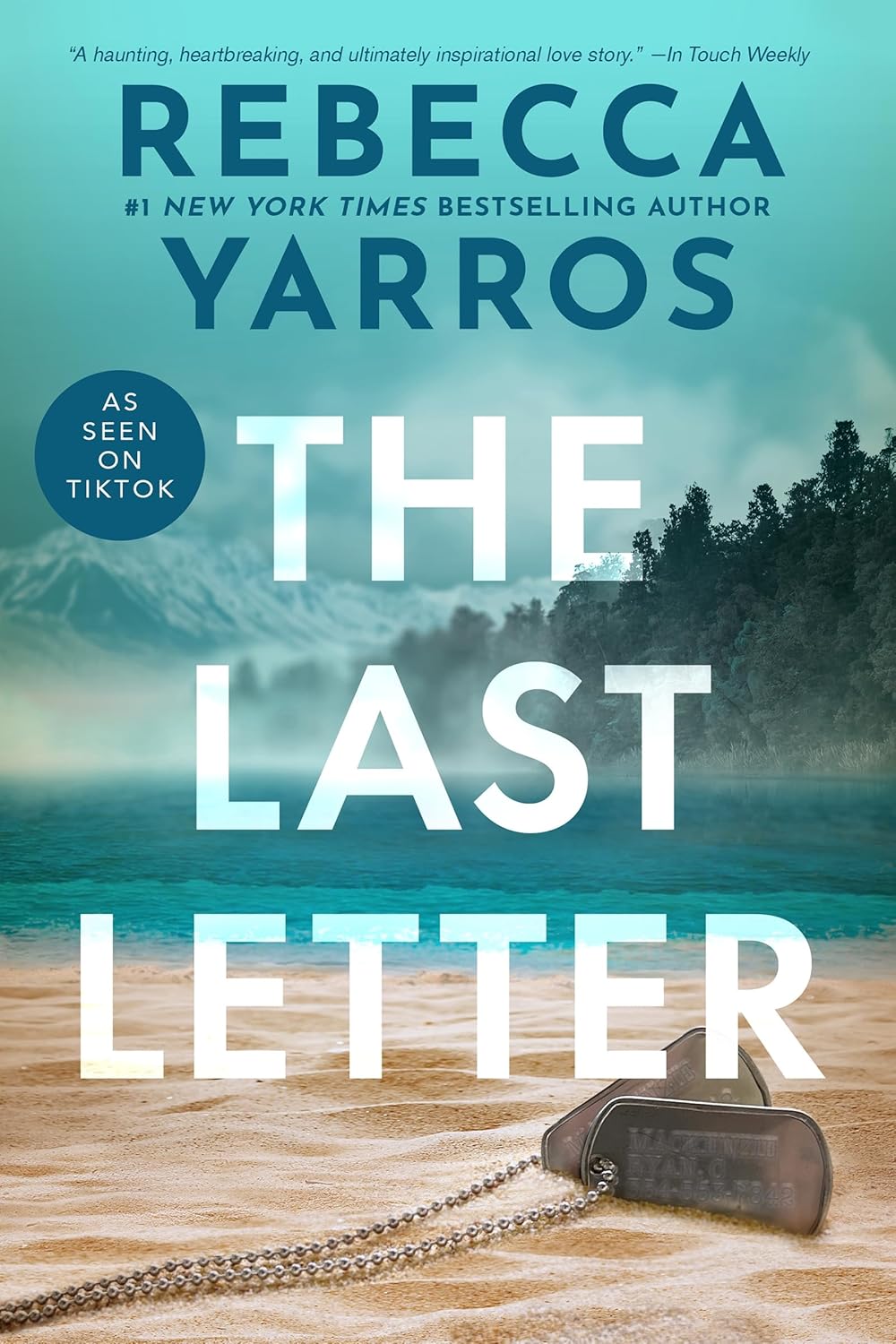
Description
There’s a particular kind of novel that seems to dare you to put it down — not because it’s badly written, but because it understands, with almost clinical precision, that you won’t. Rebecca Yarros’s The Last Letter belongs firmly in that category. It is a book that grips you by the collar from the first page, refuses to loosen its hold, and leaves you somewhere between wrung-out and uncertain whether you were seduced or simply ambushed. I picked up the ebook late on a Tuesday and surfaced sometime around two in the morning, unsettled in ways I hadn’t quite anticipated.
Set against the rugged mountain backdrop of Telluride, Colorado, this is a contemporary romance laced with considerable grief — a military love story, essentially, though that label undersells the emotional territory the novel insists on covering. At its center is Ella MacKenzie: single mother, innkeeper, and a woman quietly enduring a weight of circumstances that would flatten most fictional characters before the midpoint. Her lifeline is an unlikely one — a correspondence with a soldier known only as “Chaos,” a man who serves alongside her brother. When that brother dies overseas, and Chaos arrives in her life in the flesh, what follows is a story of identity, deception, guilt, and the kind of slow-burn intimacy that can only exist between two people who are too damaged to approach each other any other way.
Yarros writes with a blunt, propulsive energy that has little interest in lingering over a sentence for its own sake. This is prose built for momentum, not beauty — utilitarian in the best sense when it’s working, and occasionally a little mechanical when it isn’t. The epistolary framing that opens each chapter is worth some attention here. At first it reads like a well-worn genre shortcut, a way to accelerate emotional intimacy without earning it through lived interaction. I’ll admit I was skeptical. But Yarros is doing something subtler than I initially gave her credit for. Both of her central characters are so comprehensively defended against real vulnerability that letters become the only container spacious enough to hold it. The distance of the page permits honesty that face-to-face proximity would immediately collapse. It’s a structural choice that, once you understand it, feels earned.
The more interesting — and more genuinely unsettling — dimension of the novel is the one it seems least willing to fully examine. The male lead’s decision to embed himself in Ella’s world under false pretenses is treated by the narrative as a form of tragic sacrifice, a love so devoted it bends the rules of ethical conduct into something almost tender. The reasoning offered is revealing: he conceals himself because he believes she couldn’t handle the truth, at least not yet, and that his presence is too urgently needed to risk exposure. I couldn’t help but notice how much the text wants us to find this romantic rather than troubling. He decides, unilaterally, what truth she is capable of receiving. Her autonomy is offered up as collateral for his protective instincts, and the novel’s emotional logic rewards him for it. Whether you find this forgivable — or even delicious, as the genre sometimes asks us to — will probably say something about your relationship to romance fiction as a form. Yarros seems less interested in interrogating this dynamic than in inhabiting it, and that choice is both the book’s greatest commercial asset and its most significant literary limitation.
What’s harder to dismiss is the pacing problem that accumulates around the novel’s midpoint. Yarros piles suffering onto her characters with a generosity that eventually begins to work against her. Grief, in fiction as in life, requires some air around it to breathe, some stillness against which the harder moments register. Here, the disasters arrive in such close succession that the emotional landscape starts to flatten, each new blow slightly less devastating than the last simply because the reader’s capacity for devastation has been quietly depleted. The quieter, more genuinely human moments of connection — and there are some lovely ones — tend to get drowned out by the noise of whatever catastrophe is approaching next.

Within the contemporary romance genre, Yarros sits comfortably alongside authors like Colleen Hoover in her willingness to treat grief and trauma as primary rather than incidental material. The Last Letter is an earlier work, and the rough edges show — there’s an ambition here that the execution doesn’t always meet. But the emotional intelligence is real, and the instinct for what readers need from this kind of story is unerring.
This is not a novel for readers who want psychological complexity neatly resolved, or who bristle at protagonists whose decisions occasionally defy scrutiny. It is, however, a novel for anyone who’s willing to be dragged through a considerable amount of pain on the promise that something on the other side is worth reaching for. Whether that extraction process feels cathartic or merely relentless is a question only the individual reader can answer — and the honest answer, for me, landed somewhere in between.


Reviews
There are no reviews yet.