
Description
Somewhere in the Devonian, a fat lobe-finned fish heaves itself across drying sand, fins splayed, hunting the next pool before its gills give out. Boyle stages this scene beautifully, then names the culprit: “it was the Moon that dragged our piscine progenitors ashore.” Watch the verb. Not the tide, not the shrinking pool, not four hundred million years of pressure sorting the fish that could gulp air from the ones that drowned — the Moon, dragging, as though it had hands.
That verb is doing the book’s whole argument, and exposing its whole problem.
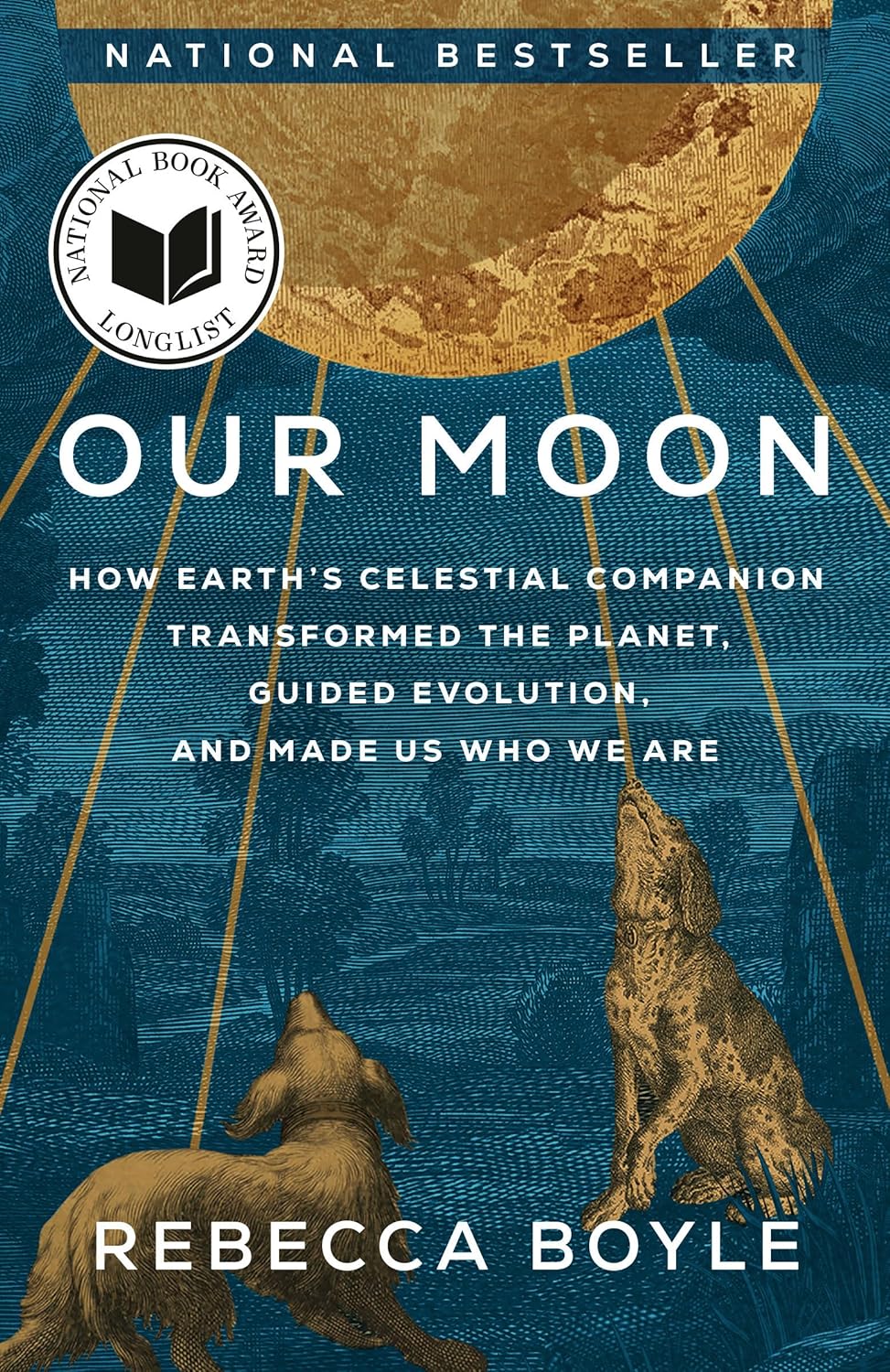
Our Moon moves in three parts: how the Moon was made, how it made us, how we made it in our own image. Boyle is a science journalist who writes with her whole body — she can make you taste a Hadean tide pool (soy sauce, she decides, umami and sour) and smell the spent-firework tang of Moon dust in the Apollo cabin. Her governing move across all three parts is to hand the Moon a personality. Chapter three calls it “The Biographer of Earth.” Elsewhere it conducts a symphony, shepherds the human mind, guides the strongest creatures to shore. The Moon is the protagonist; fish, tides, and civilisations are the supporting cast it pushes around.
The device is lovely. It is also where the book quietly overspends.
Look at what the science under these chapters actually says. The tetrapod story — fish walking because the Moon beached them — rests on a 2014 paper by the astrophysicist Steven Balbus and the tidal simulations of an oceanography student, Hannah Byrne. To her credit, Boyle goes to Byrne, sits with her supercomputer models, and lets Byrne puncture the very story the chapter is selling. “It’s all lies, what you have been told,” Byrne says, half joking, and then shows why: the extreme tides that may have stranded those fish depended less on the Moon than on the shape of the ancient coastline and the configuration of ocean basins before Pangaea closed, water sloshing in a basin sized just so. The Moon supplies the pull. Geography decides whether the pull matters. So which one dragged the fish?
This is the pattern throughout. The boldest agency-language sits on the thinnest evidence and relaxes exactly where the evidence firms up. Writing about the tide tables that failed the marines at Tarawa, or about the lunar clocks ticking inside sea lice and coral — creatures that spawn to a calendar written in their genes — Boyle stands on rock, and her confidence is earned. A coral with no eyes timing its one night of release to the full Moon is a claim you can test, and it holds. But “the Moon made us who we are” is a different order of statement, and the word “made” keeps shifting underfoot. In Part I it means physics: gravity, accretion, the literal shearing of Moon-stuff from a molten Earth. In Part II it slides toward “enabled,” then toward “caused,” on evidence Boyle herself softens with probably and maybe and as far as we know. A reader who trusts the hedges and a reader who trusts the verbs finish the same chapter believing two different things.
I don’t think this is dishonesty. It is closer to enthusiasm outrunning its footing — a writer so taken with her subject that she keeps promoting a background condition to a leading role. And here is the strange part: the book grows stronger the moment it drops the promotion. Part III, where humans make the Moon instead of the reverse, is where her instinct proves right. “The Moon says nothing for itself, but it says plenty about us.” That sentence could be the book’s thesis, and it points the opposite way from the title. The Warren Field pits, the Chimney Rock towers cradling a standstill moonrise, Jeff Bezos and a Mesopotamian scribe both looking up and seeing riches — these chapters work because the Moon is finally allowed to be what the evidence best supports: a mirror, a blank surface the species paints itself onto. No agency required. It hangs there while we project.
Which leaves a tension the book never settles, and perhaps cannot. Boyle wants the Moon to be both the author of our biology and the screen for our dreams, cause and canvas at once. Those are different relationships, and one verb cannot carry both without strain. The memoir threading is the connective tissue — her grandfather praying the rosary in a foxhole while the dodging tide killed marines on the beach above him; her daughter chattering through a thousand-year-old kiva — and it is warm, unforced work, though it also smooths the seam where physical causation ends and cultural projection begins.
Go back to the fish. It did not know it was being dragged; it was trying not to die, the water happened to withdraw, and it happened to carry the fins to follow. Boyle’s Moon reaches down and hauls it up the beach into our future. The likelier story is duller and odder: the Moon pulled, the coastline did the shaping, chance did the rest, and a fish crawled. She has written the thrilling version. The quieter one is the account her own scientists keep handing her.


Reviews
There are no reviews yet.