
Description
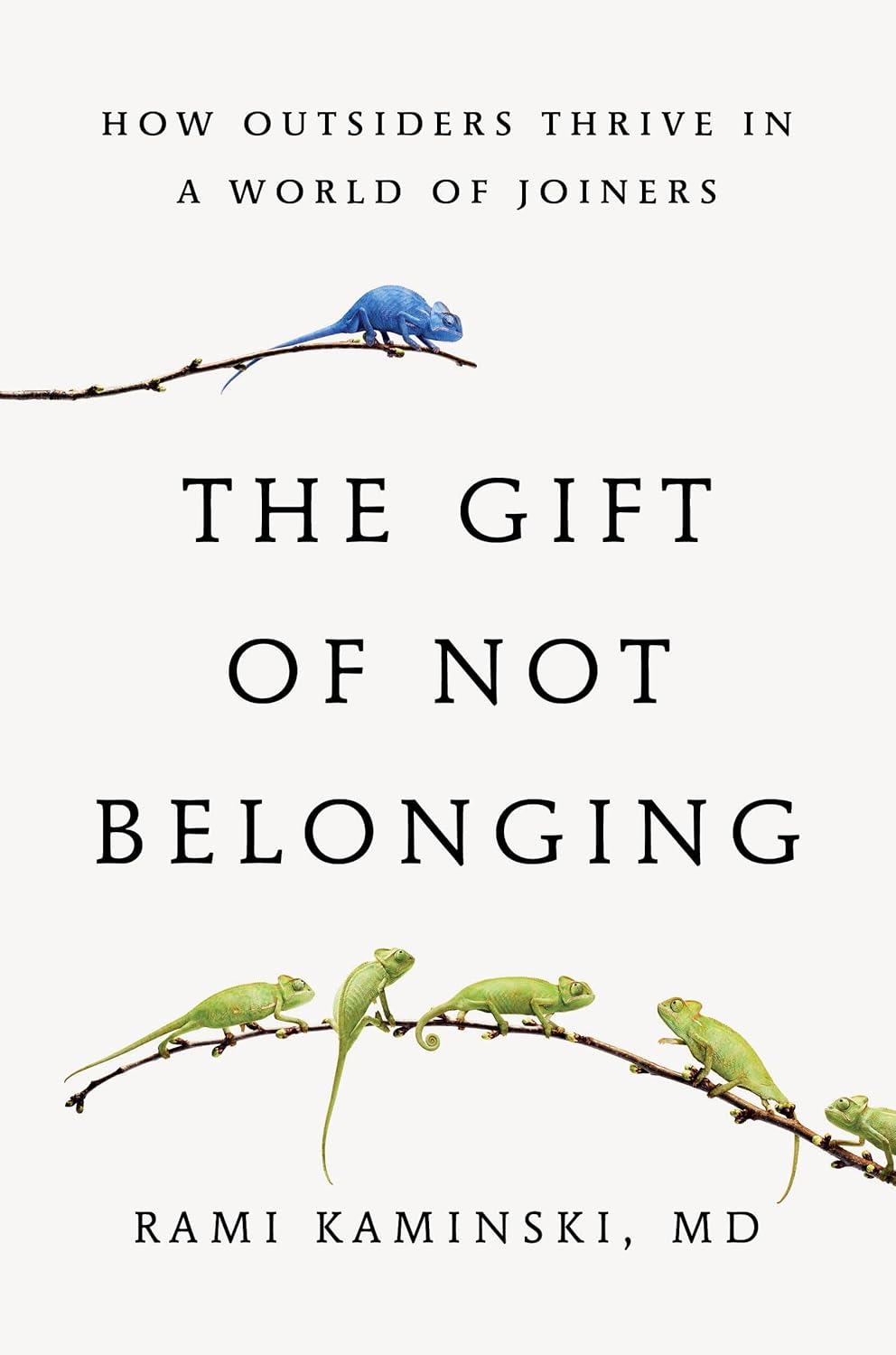
The last thing The Gift of Not Belonging asks of its reader is arithmetic. Forty statements, each scored from one to seven; reach 188 and you are, in Rami Kaminski’s coinage, an otrovert — someone built without the impulse to belong. Fall below 188 and you are not. The chapters before it have argued that this trait is real, inherited, and impossible to counterfeit, and then the appendix hands you a sum to settle which side of the line you fall on.
Kaminski, a psychiatrist of more than forty years, has spent his career with people who feel they belong nowhere — and he is careful to wall this group off from the shy, the socially anxious, the autistic, and the cast-out. What remains is a quieter type he says has gone unnamed: the outsider who is treated like an insider. Invited, liked, sometimes adored, and still never part of the room. The otrovert, he proposes, is as basic a category as the introvert or extrovert, and the book’s promise to anyone who recognizes themselves in it is relief. The trouble you have spent your life trying to fix was never a flaw. It was a temperament.
For a certain reader this will land as a kindness, and the kindness is not fake. One of Kaminski’s patients had spent two years bedridden, cycled through diagnoses and medications and rehab programs that did not fit, absorbing each failure as proof of her own laziness. To tell such a person that her difficulty is a way of being rather than a personal defect is a real gift, and Kaminski’s instinct for it is well earned. Decades ago he noticed that some psychiatric patients labeled “treatment non-responders” were not failing their treatment so much as being treated for the wrong illness; the program he built on that hunch returned hundreds of long-institutionalized people to ordinary life. The otrovert idea works the same way. Maybe the person isn’t broken. Maybe the category is.
But the category has to carry weight the book handles carelessly. Kaminski insists, more than once, that otroversion admits no degrees: “It’s binary; you either are or are not an otrovert, which means either you buy into the hive mind or you don’t.” He insists on its permanence too: “Much like left-handedness, being an otrovert is a cognitive feature, deeply embedded in our brain’s wiring.” These aren’t decorative lines. The consolation depends on them. “This is simply who you are, stop fighting it” only consoles if there is a fixed who to point at — something inherited, not picked up during a hard adolescence and possibly shed after one.
The left-handedness comparison asks for more than it can pay. Handedness can be observed by anyone, measured without consulting the person’s feelings, traced to something physical in the body. Otroversion, as Kaminski describes it, is defined entirely by an inner sensation, identified by him in his own patients, and confirmed by a quiz he wrote. Read its items — I feel lonely in large social gatherings; I need a lot of time by myself; I am an observer of life, not an active participant — and you find the definition of an otrovert restated as questions. An instrument tuned to register a trait will register it. That tells you the author is consistent. It does not tell you the trait carves anything real.
There is a reading on which none of this matters. A frame that gets someone out of bed has done something no abstract objection can undo, and for a while I was willing to leave the question there.

The book will not let me. It does not merely console; it prescribes. It tells the parents of a withdrawn fourteen-year-old not to intervene. It tells otroverts that the effort to fit in is “futile.” It tells couples how to run a marriage between a belonger and a non-belonger. Counsel of that weight is only as sound as the claim that the trait is real and permanent — and if a quiet teenager is in fact socially anxious in a way that treatment would ease, “leave him be, he’s an otrovert” is the wrong advice, delivered warmly.
A second strain runs through the book that Kaminski never reconciles. Otroverts, in his account, are not only different from communal people but better: more original, more empathetic, “compelled to be considerate,” while the majority barters, competes, and discriminates. The conclusion hardens this into politics, setting the otrovert against what he calls the Trumpian hive mind. A book whose stated moral is the dismantling of “us versus them” has spent most of its length describing a majority and handing it the lesser virtues. The gentlest imaginable book about not belonging has, almost without noticing, assembled an in-group of its own.
As a boy, Kaminski writes, he came to understand that he was neither the ugly duckling nor the swan but some third kind of bird entirely. It’s a moving image, and it does precisely what the book does: it offers a name to people who have lacked one. A name can be a real comfort. Whether it is also a discovery is the one question this book is too certain of itself to ask.


Reviews
There are no reviews yet.