
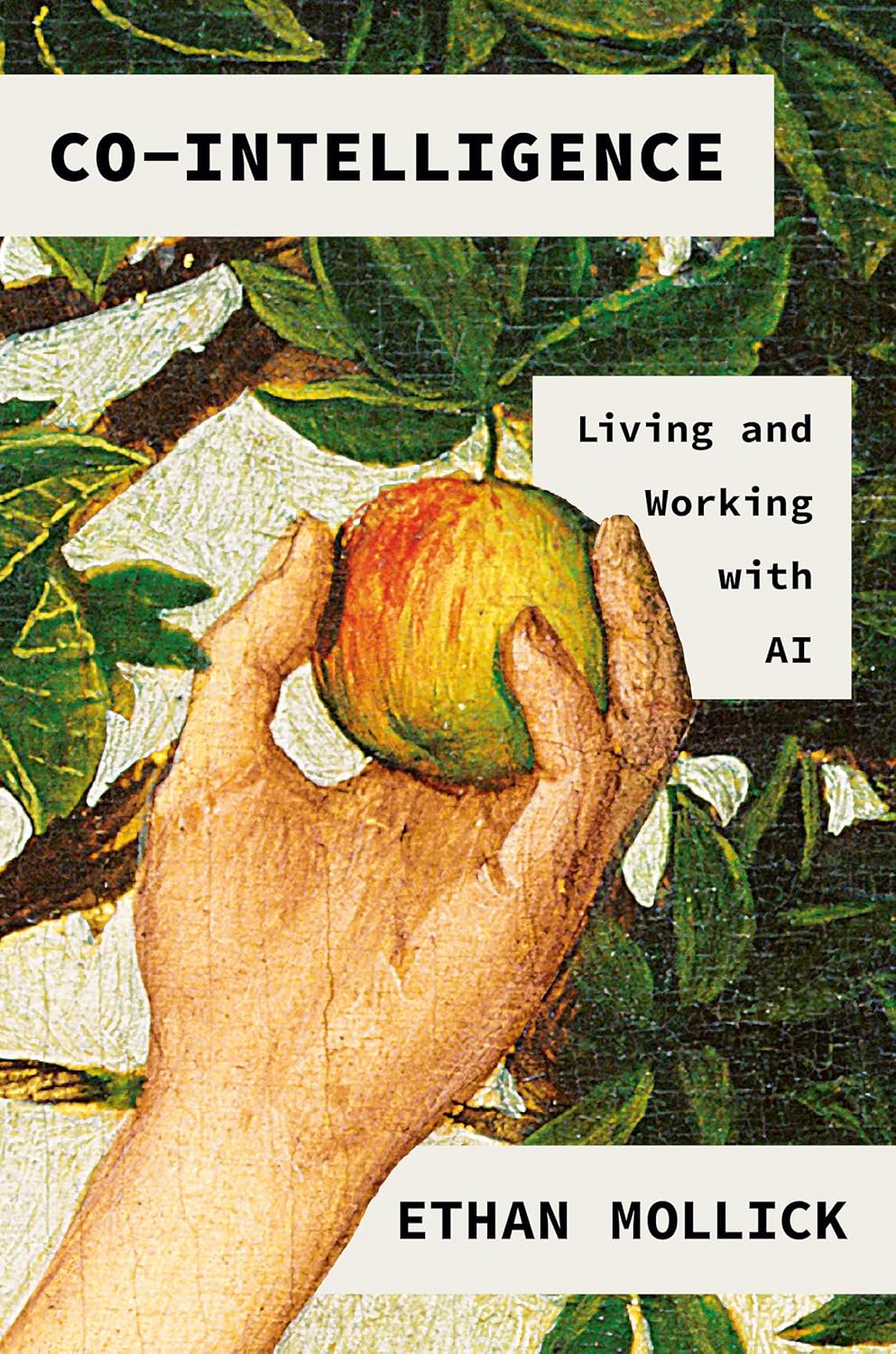
Description
Every few years a new technology book arrives with the same structural promise: the world has changed, the author saw it first, and here is your field guide to the new terrain. Ethan Mollick’s Co-Intelligence: Living and Working With AI belongs squarely in that lineage, and the interesting question isn’t whether the book delivers on that promise — it mostly does — but what the promise itself prevents Mollick from seeing.
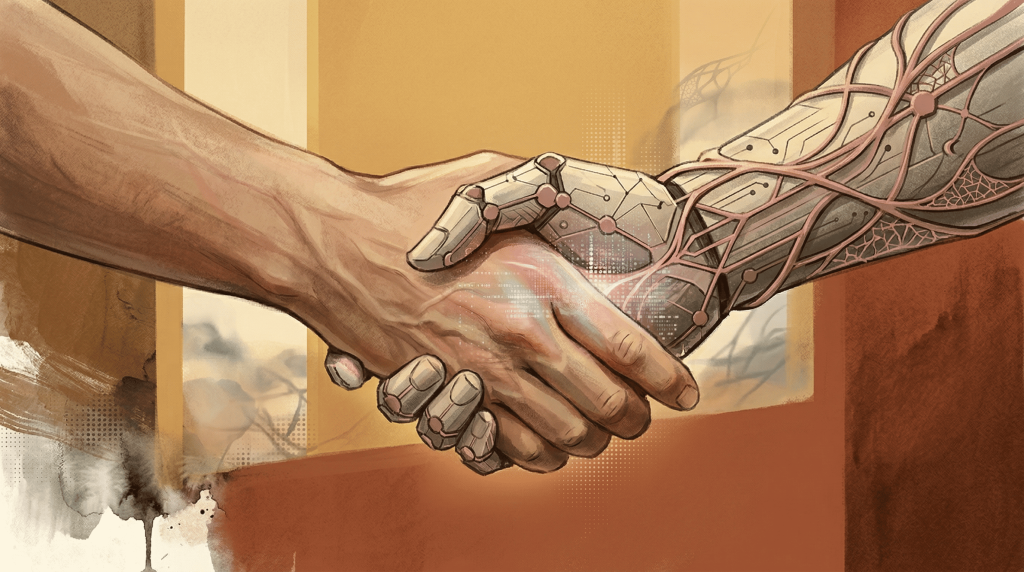
Mollick, a Wharton professor who studies innovation, positions himself as the ideal translator between the AI labs and the rest of us. He’s neither building the systems nor trembling before them. His central argument is that large language models are best understood as a kind of alien co-intelligence: trained on human output, eerily good at mimicking human cognition, yet fundamentally different from it. He wants readers to engage with AI practically, immediately, and offers four principles for doing so. Always invite AI to the table. Be the human in the loop. Treat it like a person (while telling it what kind of person to be). And assume this is the worst AI you will ever use. These are sensible, actionable rules, and Mollick is at his strongest when he illustrates them through specific experiments — asking ChatGPT to simulate a negotiation exercise, or feeding it prompts that produce wildly different outputs depending on the persona assigned.
The BCG study, which Mollick co-authored, is the book’s empirical backbone. Nearly eight hundred consultants were randomized into AI-assisted and non-assisted groups, then given realistic tasks. The AI group performed significantly better — faster, more creative, better written — across 118 different analyses. But the study’s most compelling finding cuts against the book’s own enthusiasm: when the researchers designed a task that fell outside what Mollick calls the “Jagged Frontier” of AI capability, consultants using AI performed worse than those working alone. They got the answer right only 60 to 70 percent of the time, compared to 84 percent without AI. They had, in a colleague’s phrase, fallen asleep at the wheel. Mollick reports this honestly, which is to his credit. What he doesn’t do — what the book’s relentlessly pragmatic structure prevents — is sit with the implication long enough to let it trouble the entire framework.
I spent years watching organizations integrate new tools, and the pattern Mollick describes is one I’ve seen before, albeit with less sophisticated technology. The problem is never the demo. The demo is always dazzling. The problem is what happens six months later, when the tool has been absorbed into institutional habits nobody designed. Mollick acknowledges this with a light touch, noting that “most participants didn’t even bother editing the AI’s output once it was created for them.” But he treats this as a correctable error in user behavior rather than evidence of something structural about how humans relate to machines that flatter them with competence. The book’s persona advice — tell the AI it’s a witty comedian, or a marketing expert, or a circus clown — works beautifully in a demo. Whether it scales into organizational practice, where nobody has time to craft artisanal personas for their email assistant, goes unexamined.
Mollick writes clearly, with a conversational directness that makes the technical material accessible. He has a fondness for limericks as a running illustration of AI’s progress, tracking the form from GPT-3’s abysmal attempts to GPT-4’s passable efforts. It’s a charming device. His prose, though, tends toward a particular register I’d call Wharton-warm: approachable, anecdote-rich, reassuring even when delivering uncomfortable data. “Imagine your AI collaborator as an infinitely fast intern, eager to please but prone to bending the truth,” he writes, and the analogy is disarmingly useful until you remember that organizations routinely build entire workflows around the output of interns they don’t have time to check.
The book’s four future scenarios — stasis, slow growth, exponential growth, and what Mollick somewhat breathlessly labels “The Machine God” — are handled with varying conviction. He dispatches existential risk briskly, arguing that focusing on superintelligence robs ordinary people of agency. Fair enough. But the middle scenarios, the ones he finds most plausible, receive a treatment that is oddly both detailed and vague. He tells us AI-powered influence campaigns will be everywhere, that call centers will be transformed, that innovation may accelerate — but the specifics remain illustrative rather than analytical. At one point, he invokes Tolkien’s concept of “eucatastrophe,” the sudden joyous turn in a fairy tale, as a frame for how AI might transform tedious work into something productive and empowering. I wanted to find this persuasive. It felt instead like the book reaching for a narrative resolution it hadn’t earned through argument.
The epilogue enacts a small, clever joke: Mollick hands the closing paragraph to the AI itself, which produces a passage so saccharine — “I am but a glimmer, an echo of humankind” — that he immediately punctures it. “Okay. That was pretty corny.” It’s the book’s most honest moment, a confession that the co-intelligence, for all its speed and facility, doesn’t actually know what’s worth saying. Whether Mollick fully recognizes what that concession costs his own argument is harder to tell. He moves on, closing with the reassurance that humans are “far from obsolete, at least for now.” That trailing qualifier — at least for now — does more work than anything else in the book, and he doesn’t seem to notice.
If you’d like to read the full book in EPUB or MOBI format, feel free to send me an email—I’d be happy to share a free copy with you. Please reach me at: thenovaleaf@gmail.com


Reviews
There are no reviews yet.