
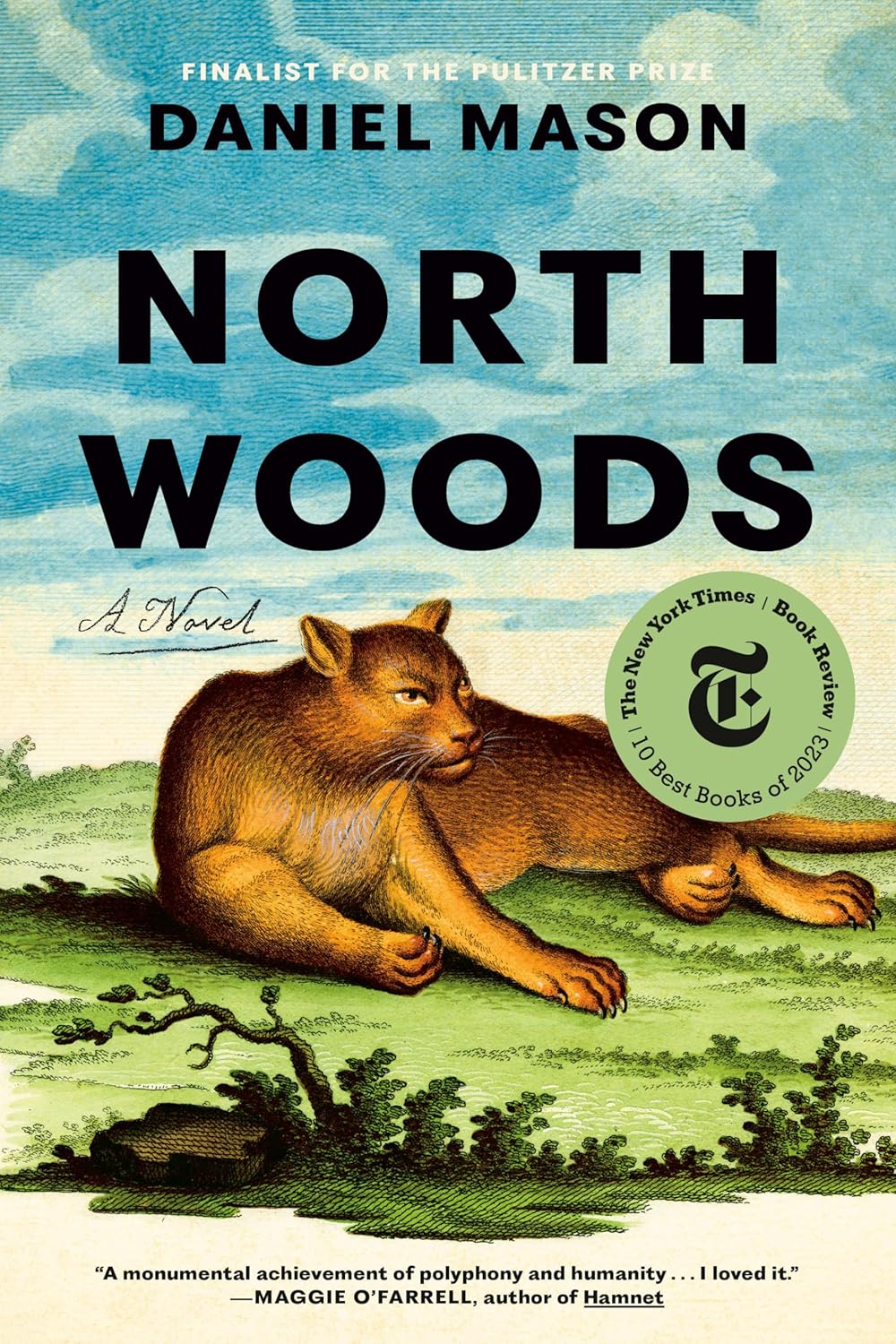
Description
An apple seed catches in the ribcage of a murdered man, and come spring it drops a root into the soil where he lies. Daniel Mason lingers over the moment — “one of the apple seeds, sheltered in the shattered rib cage, breaks its coat, drops a root into the soil, and lifts a pair of pale-green cotyledons” — with the patience of someone who has decided the corpse is not the point. The tree is the point. Or rather the succession is: the orchard that rises from that seed, the twin daughters who tend it, the painter and murderers and ecologist who pass through the yellow house downhill, each of them soil for whatever comes next.
North Woods follows a single patch of western Massachusetts across roughly four centuries, from two lovers fleeing the Colony to a far-future fire that clears the ground for the cycle to restart. Mason tells it as a chorus of forms: a captivity letter, a mock-orchardist’s memoir, ballads, a true-crime broadside, an estate agent’s listing, case notes on a mad painter, and, threaded between, chapters of close nature-prose. The house burns and is rebuilt. The apple is grafted onto graft onto graft. The ghosts of former residents linger, complaining, noticing, unable to leave.
Late on, the book’s youngest ghost — Nora, an ecologist who dies near the house and stays — arrives at what reads as the novel’s thesis. Worn down by blight after blight (chestnut, elm, ash, hemlock: the roll-call of North American forest collapse), she decides that “the only way to understand the world as something other than a tale of loss is to see it as a tale of change.” It is a consolation offered in good faith. Change is not ending; the forest that dies is a forest becoming another forest; grief is a failure of the long view.
I want to believe her. Mason clearly wants me to. And the book’s quietest, cruellest move is that it will not let either of us.
Because watch what the novel does, as against what it says. Its method is retention. Nothing here is allowed to fully pass. The dead do not disperse into soil; they become ghosts and stay, pacing the halls, retelling the story of a bayonetting for the ninety-seventh time. A line from the first chapter — a wife laughing that there could not be room for so much life, “a thousand angels on a blade of grass” — comes back four hundred pages later, word for word, as an elegy for the damselflies and elms now gone. The apple is the same apple, cutting after cutting. Mason has built the whole book on the principle that the past does not release its grip.
So the thesis and the architecture pull against each other, and the pulling is the real subject. “Change, not loss” is what the mind concludes. The ghosts are what the heart does instead, which is to refuse. You cannot sit through the twins’ story — Alice favoured, Mary overlooked, the slow tragedy of a jealousy that curdles a whole life — and then accept that their vanishing is only the forest turning over. Mason knows this. He grants Nora her consolation and then hands her an eternity of watching the things she loves disappear.
Where the book strains is in trusting that consolation more than it has earned. Nora’s chapter, for all its tenderness, keeps reaching for the essay — the museum wall-texts, the extinction figures, the virtual-reality chestnut grove — and the reaching thins what the earlier voices won by indirection. When the captivity letter renders a woman’s terror in the crabbed spelling of a seventeenth-century hand, or the orchardist’s memoir spins its comic theory of a madness lodged in the brain’s “lesser operculum,” the idea arrives smuggled inside a voice. Nora’s chapter states its ideas outright. It tells you the forests are astonishing and dying; the twins’ chapter merely lets you watch two women share a mattress for decades, then declines to spare you what follows.
And yet — here I catch myself, because the flattening may be the point. Nora is a scientist; of course her comfort arrives in the register of the lecture hall, the only register her discipline gave her. Read that way, the chapter is not a lapse but a demonstration: the mind’s best theory, stated plainly, found wanting against the ghost it is about to become. I’m not sure Mason fully controls this. I’m not sure he doesn’t.
What stays, in the end, is the image the thesis was built to soothe. The captive poisons the soldiers to stop the killing and buries them in the meadow; the apple grows up through the ribs of the man who offered her the fruit; and centuries on, a wife’s throwaway line about angels on a blade of grass returns to name everything the land has lost. The book tells you this is change. It shows you a haunting. Between those two claims Mason declines to choose, and the refusal rings truer than either would alone — the forest does not pause for our recognition, and neither, it turns out, do the dead.
If you’d like to read the full book in EPUB or MOBI format, feel free to send me an email—I’d be happy to share a free copy with you. Please reach me at: thenovaleaf@gmail.com


Reviews
There are no reviews yet.