
Description
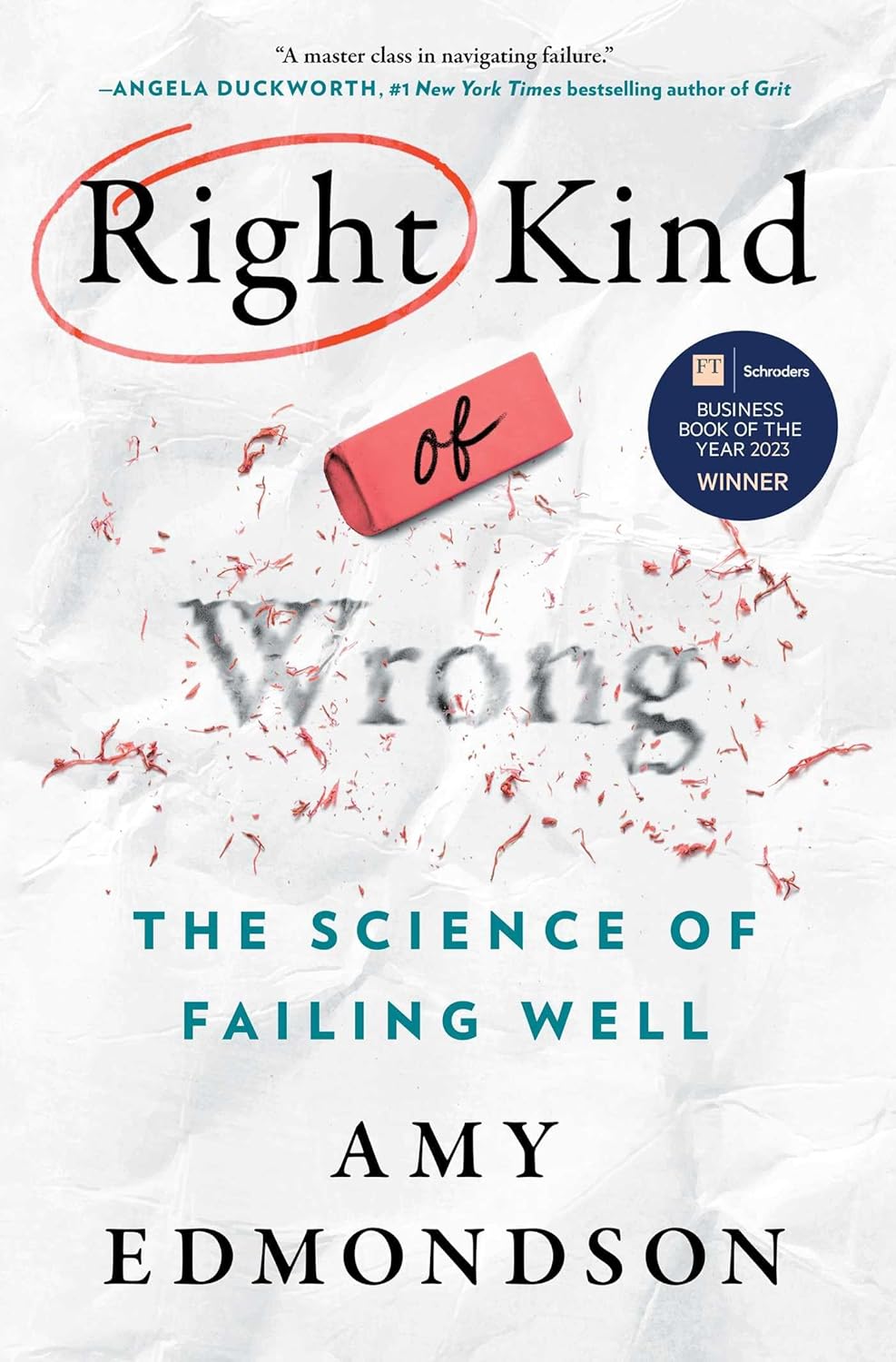
Every management thinker eventually arrives at failure. It’s the field’s gravitational center, the subject everyone wants to have solved and nobody has. Amy Edmondson’s Right Kind of Wrong: The Science of Failing Well enters this crowded space with a taxonomist’s confidence, proposing that we’ve been confused about failure because we’ve been lumping all of it together—and that sorting it into three clean categories will set us free. Having spent fifteen years advising organizations on risk and operational resilience, I opened the book expecting to find either useful friction or polished evasion. I found, somewhat unsettlingly, both.
The framework is this: failures are intelligent (discoveries born from venturing into genuine uncertainty), basic (preventable errors caused by inattention, fatigue, or missing knowledge), or complex (multi-causal breakdowns where several small problems align, sometimes with a pinch of bad luck). Edmondson, a Harvard Business School professor best known for her work on psychological safety, builds outward from her own origin story—a doctoral study where better hospital teams appeared to make more medication errors, a finding that shattered her hypothesis and ultimately revealed that those teams were simply more willing to report mistakes. The prologue, set in a cramped office in William James Hall, 1993, watching data contradict her on a Macintosh screen, is the book’s most persuasive passage. Edmondson is a good memoirist of her own confusion.
From there, the architecture proceeds neatly. Part One walks through each failure type; Part Two addresses the self-awareness, situation awareness, and system awareness needed to navigate them. Case studies arrive on schedule: Thomas Edison’s battery experiments, the Hyatt Regency walkway collapse, René Redzepi’s near-bankruptcy at Noma, Barbe-Nicole Clicquot’s champagne empire, Boeing’s MCAS software. The book closes with the question of how to “thrive as a fallible human being,” a phrase Edmondson borrows from psychiatrist Maxie Maultsby—abbreviated, with evident fondness, as “FHB.”
The taxonomy does what good taxonomies do: it gives you language. And I’ll concede that simply having the words “intelligent failure” available changes how a team debriefs a failed product launch. Where the framework starts to buckle, though, is at the borders between categories. Edmondson acknowledges that context matters—a basic failure can happen in a lab, an intelligent one on an assembly line—but she treats these as manageable exceptions rather than as evidence that the categories themselves leak. In practice, most organizational failures I’ve encountered are simultaneously basic and complex, with an intelligent veneer applied retroactively by whoever writes the postmortem. The line between “we didn’t know” (intelligent) and “we should have known” (basic) is drawn by whoever holds the narrative afterward. Edmondson doesn’t ignore this ambiguity, but she doesn’t let it destabilize her scheme either.
The psychological safety material, which earned Edmondson her reputation, is here presented as the connective tissue linking all three failure types. If people feel safe to report errors, basic failures get caught. If they feel safe to voice concerns, complex failures get interrupted before cascading. If they feel safe to experiment, intelligent failures proliferate in productive ways. The logic is sound, and over a thousand research papers apparently support it. But I keep thinking about Julie Morath, the hospital executive in the book who replaced the word “investigation” with “study” to make clinicians less defensive—”Words to Work By,” she called it. The relabeling worked. Error reporting increased. Patient safety improved. And yet something about this sits uneasily: at what point does reframing failure as learning become its own form of institutional euphemism? Edmondson quotes Morath explaining that health care is “a complex error-prone system,” and the lesson drawn is that blame should be suspended. Correct, up to a point. But the book’s enthusiasm for blamelessness never quite reckons with environments where accountability has been so thoroughly dissolved that nobody owns anything at all—where “psychological safety” becomes a shield for mediocrity rather than a precondition for candor.
A section near the end on the unequal license to fail comes close to cracking the framework open entirely. Edmondson cites journalist Adam Bradley’s observation that whiteness confers a freedom to fail without the failure being taken as representative of an entire group. She notes that James West, the African American inventor with over 250 patents, was repeatedly mistaken for a janitor at Bell Labs. This is powerful, and Edmondson deserves credit for including it. But the passage occupies barely a page before the book returns to its coaching register—play to win, reframe your setbacks, cultivate curiosity. The structural insight never irrigates the practical advice. If your failures are taxed differently depending on your race or gender, then “failing well” isn’t primarily a cognitive skill; it’s a privilege that some people can practice and others are penalized for attempting. Edmondson sees this. She states it plainly. Then she moves on, and the taxonomy closes behind her like water.

The prose is warm, occasionally conversational, and constructed for accessibility. Edmondson’s instinct as a writer is to disarm rather than provoke—to offer you the cookie jar before asking you to examine it. “Failing well, perhaps even living well, requires us to become vigorously humble and curious—a state that does not come naturally to adults.” That sentence lands gently, but I’m not sure vigorous humility can be taught through typology. Humility, in my experience, comes from having your framework fail you—not from learning a better one.
What stays with me isn’t the three-part model or the awareness triad. It’s the Macintosh screen in 1993, the wrong-direction correlation, and a graduate student forcing herself to ask: What if the data means something I didn’t expect? That question—not the answer she eventually published, not the concept of psychological safety, not the TED talk or the bestseller—is the actual engine of the book. Everything Edmondson built came from one moment of refusing to look away from results she didn’t want. Whether a taxonomy of failure can reproduce that instinct in a reader, or merely describe it, is a question the book raises without quite knowing it has.
If you’d like to read the full book in EPUB or MOBI format, feel free to send me an email—I’d be happy to share a free copy with you. Please reach me at: thenovaleaf@gmail.com


Reviews
There are no reviews yet.